
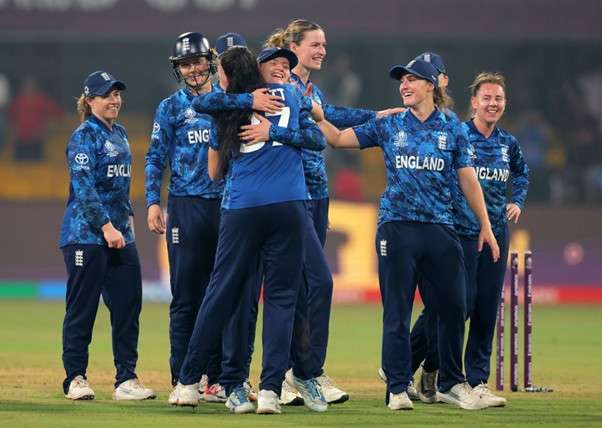
Hosts England have regained form at the right time and are looking good ahead of the ICC Women’s T20 WC 2026. Playing in front of their home crowd will be a massive advantage for England. We must not forget that England won the T20 World Cup in 2009 here in England, but have not achieved success in the shortest format since. So, the hosts will be pumped up and looking forward to winning it this time.
They will be led by Nat Sciver Brunt, who is battling fitness issues, but looks good to be fit for the start of the tournament. She is an able leader, and they are coached by veteran player and legend Charlotte Edwards. England have their strengths and weaknesses as well, and plenty of them at that. We will try to emphasise that for you here.
Strengths
- Home Conditions and Crowd Support: England knows the venues, pitches, and weather conditions better than any other team. Familiarity with grounds such as Lord’s, the Oval, Edgbaston, and Old Trafford could prove decisive in high-pressure encounters. Home crowd matters a lot, and that could prove decisive as well.
- World Class All-Round Core: The team is built around match-winners such as Nat Sciver-Brunt, Sophie Ecclestone, Alice Capsey and Heather Knight. Their ability to contribute across multiple disciplines gives England tremendous flexibility in T20 cricket.
- Explosive Batting Line-Up: England possesses one of the most aggressive batting units in the competition. The recent series-winning chase of 181 against India highlighted their firepower, with Alice Capsey and Heather Knight producing a record partnership under pressure.
- Strong Spin Resources: Sophie Ecclestone remains among the most dangerous T20 bowlers in the world. Combined with part-time spin options throughout the squad, England have the tools to control middle overs and attack opposition batters.
Weaknesses
- Dependence on Sciver-Brunt: Although England has depth, much of their balance revolves around Nat Sciver-Brunt’s batting and leadership. Any dip in form or fitness could significantly affect the side. She recently returned from a calf injury and is expected to play primarily as a batter.
- Pace Bowling Depth: England’s seam attack is effective in home conditions, but there are questions about whether it possesses the same intimidation factor as some rival nations, particularly Australia.
- Finishing Consistency: The lower middle order has occasionally struggled to accelerate consistently in tight contests, placing extra responsibility on the top order batters.
- Pressure of Expectations: Hosting a World Cup can be a double-edged sword. England will face intense scrutiny and expectations from fans and media throughout the tournament. This will be the biggest challenge for England.
Opportunities
- Home World Cup Advantage: England has a rare opportunity to capitalise on familiar conditions and strong crowd support to end their long ICC trophy drought. They last won the T20 World Cup in 2009 and the ODI World Cup in 2017, both times at home in England.
- Emergence of Young Stars: Alice Capsey has developed into one of the most exciting young players in world cricket, while England has also backed promising youngsters in their World Cup squad.
- Momentum from Recent Results: The series victory over India just before the World Cup has boosted confidence and demonstrated the team’s ability to chase big totals under pressure, and could act as a catalyst to do well in this tournament.
- Leadership Transition Appears Smooth: Charlotte Edwards’ arrival as head coach and Sciver-Brunt’s captaincy have injected fresh energy into the side heading into the tournament, which will be huge for the hosts to do well.
Threats
- Australia’s Tournament Pedigree: The biggest challenge for any team, let alone England, remains the formidable Australia Women’s Cricket Team, who continue to set the benchmark in women’s cricket. To match them and upstage them will be a huge challenge for the hosts.
- Strong Competition from India and New Zealand: Both the India Women’s National Cricket Team and New Zealand Women’s National Cricket Team possess the talent and experience to challenge England deep into the tournament.
- Injury Concerns: A long tournament increases the risk of injuries to key players, particularly all-rounders who shoulder lots of heavy workloads.
- Knockout Match Pressure: England have occasionally fallen short in crucial ICC knockout matches despite entering tournaments as favourites. Handling those moments will be critical. If they are unable to handle pressure, they will falter again.
England’s Squad for T20 Women’s World Cup 2026
Nat Sciver-Brunt (c), Charlie Dean (vc), Alice Capsey, Sophia Dunkley, Amy Jones (wk), Heather Knight, Danni Wyatt-Hodge, Dani Gibson, Freya Kemp, Lauren Bell, Tilly Corteen-Coleman, Sophie Ecclestone, Lauren Filer, Linsey Smith, Issy Wong.
Expected Performance for England in Women’s T20 WC 2026
England have been placed in Group 2, where they have New Zealand, Sri Lanka, West Indies in their ranks alongside Ireland and Scotland. England have two perfect warm-up games to warm themselves as they face Australia tomorrow at 7:30 PM IST before facing India on June 10th at 2:30 PM IST. England open their World Cup campaign against Sri Lanka on June 12th at 11 PM IST. They will then face Ireland on 16th June at 11 PM IST. Scotland faces them on 20th June at 11 PM IST yet again.
Then on 24th June, they play West Indies before facing New Zealand in their last league game on 27th June. All the England games are set to start at 11 PM IST. Looking at current form and the group set up, England will be mightily disappointed if they don’t reach the semis. We see England storming into the semis and then taking it from there. They should make the final 4. Whether they lift the trophy remains to be seen, and how they perform in the knockout stages of the tournament.
We shall wait and see how England fare in their home World Cup and whether they can indeed reclaim glory again. Is it coming home? Only time will tell.
Also Read: ICC Women’s T20 WC 2026: Smriti Mandhana Backs Shafali Verma To Open Batting