
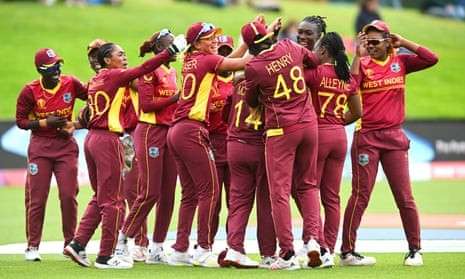
When looking at the 15 players selected by Cricket West Indies (CWI) for this UK-based campaign, there was an immediate realization that this team rejects the modern blueprint of hyper-specialization. Head Coach Shane Deitz and selector Miles Bascombe have doubled down on a roster stacked with multi-dimensional all-rounders. It is an approach built on tactical flexibility, yet it carries glaring structural imbalances that will be severely tested under English skies.
Evaluating this squad through a cold, analytical lens reveals distinct tactical zones that will dictate whether the West Indies can replicate their historic 2016 triumph, or find themselves knocked out before the semi-finals in a brutal Group B.
West Indies Squad for 2026 T20 World Cup
Hayley Matthews (C), Chinelle Henry (VC), Deandra Dottin, Stafanie Taylor, Shemaine Campbelle (WK), Afy Fletcher, Karishma Ramharack, Qiana Joseph, Aaliyah Alleyne, Zaida James, Ashmini Munisar, Jahzara Claxton, Jannillea Glasgow, Shawnisha Hector, Mandy Mangru
SWOT Analysis
Strengths: The World Class All-Rounders Core
The absolute ceiling of this team remains remarkably high due to a handful of elite, multi-skilled players who can independently hijack a T20 match.
-
The Power of Dual Utility: In Hayley Matthews, Deandra Dottin, and Chinelle Henry, the West Indies possess cricketers who offer real, top-tier value with both bat and ball. This prevents the captain from being backed into a corner; Matthews frequently has six or seven viable bowling options to manipulate matchups based on real-time data.
-
Veteran Match-Winners: The presence of Dottin, Matthews, and Stafanie Taylor means this squad features a leadership core that understands the psychological weight of World Cup pressure. Dottin’s boundary-clearing capability in the death overs remains elite, allowing the lower-middle order to score in rapid, high-impact bursts against pace.
Weaknesses: Top-Order Reliance and Lacking Strike-Rotation
When analyzing the mathematical distribution of their runs, a stark, structural vulnerability comes to light
- Matthews Dependency Risk: The West Indies’ batting unit orbits almost entirely around Hayley Matthews. When she anchors the innings and blasts pasts the poweplay, the team regularly posts or chases competitive scores. If opposition teams dismiss her within the first six overs, the scoring velocity drops off a cliff.
- Middle-Over Stagnation: While Stafanie Taylor and Shemaine Campbelle provide incredible stability, their recent strike-rotation metrics against high-quality spin reflect a slowing down. They hit fewer low-risk gaps, forcing younger players like Qiana Joseph or Zaida James into high-leverage situations where they must hit boundaries immediately or risk letting the required run-rate spiral.
- Inexperienced Seam Depth: The squad has a heavily spin-centric defensive identity. Outside of Chinelle Henry and Aaliyah Alleyne, their fast-bowling stocks lack extensive exposure to international pressure. If pitches require sustained, high-speed seam movement, the backup seam options can be vulnerable to leaking runs.
Opportunities: Fast Outfield and Spin Choke Conditions
- Maximizing Shorter Boundaries: English outfields are typically fast, and venues like Bristol and Headingley offer shorter square boundaries. For pure power-hitters like Henry and Dottin, this reduces the need for pure timing; their raw bat speed is enough to clear the boundaries.
- The Middle-Over Spin Weapon: If June heat dries out the pitches later in the tournament, the spin tandem of leg-spinner Afy Fletcher and off-spinner Karishma Ramharack becomes highly dangerous. Fletcher is exceptional at altering her speeds to force cross-bat errors, while Ramharack can be deployed to choke the scoring rates of left-handed batters during the middle overs.
Threats: The English Elements and Disciplined Blueprints
The external variables in Group B leave absolutely zero room for tactical or physical errors.
- Overcast Conditions vs. Limited Footwork: Early-summer English conditions mean overhead swing is highly likely, especially during late-afternoon starts. Several West Indian top-order batters rely heavily on hand-eye coordination rather than precise technical footwork. Against an elite swinging ball—like England’s opening attack at Lord’s—the top order is highly susceptible to sudden collapses.
- Operational Penalties: Fielding consistency has been an ongoing issue for this unit. Dropping elite international batters early on can completely derail their defensive plans. Furthermore, slow over-rate penalties remain a persistent threat; forcing Matthews to bring a fielder into the inner circle during the final overs of a tight chase is a tactical luxury modern oppositions will punish immediately.
World Cup Group B Fixtures Table of West Indies
| Match # | Opponent | Date | Venue | Local Start Time / IST |
| 1 | New Zealand | June 13, 2026 | Utilita Bowl, West End | 18:30 Local / 23:00 IST |
| 2 | Scotland | June 18, 2026 | Headingley, Leeds | 18:30 Local / 23:00 IST |
| 3 | Sri Lanka | June 21, 2026 | Gloucestershire Cricket, Bristol | 10:30 Local / 15:00 IST |
| 4 | England | June 24, 2026 | Lord’s Cricket Ground, London | 18:30 Local / 23:00 IST |
| 5 | Ireland | June 27, 2026 | Gloucestershire Cricket, Bristol | 14:30 Local / 19:00 IST |
Analytical Prediction
The West Indies enter the 2026 World Cup as the ultimate high-variance side. They are not a clinical machine like Australia, nor do they possess the uniform depth of England. Instead, they are an explosive group of match-winners. While the team will likely clear hurdles against Scotland and Ireland, their tournament life depends entirely on splitting the differences against New Zealand and Sri Lanka. A single early collapse against swinging conditions will derail their NRR safety margin.
Also Read: ICC Women’s T20 WC 2026: Hosts England Aims To Do A 2009 Encore