
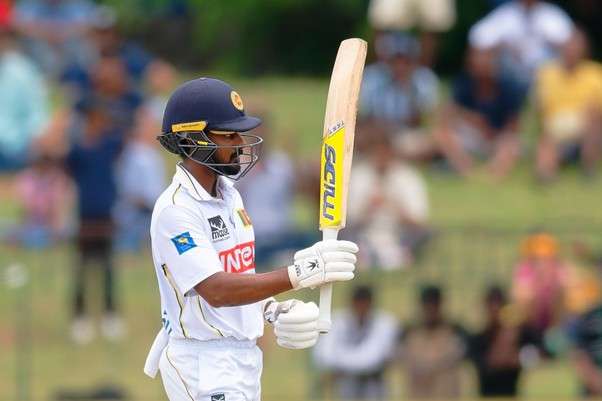
Pasindu Sooriyabandara composed 80, giving the hosts a much-needed lift, but a century remained just out of reach as India continued to dominate the Colombo Test. Pasindu Sooriyabandara produced one of Sri Lanka’s most encouraging performances of the second Test against India, but his impressive knock ended agonisingly short of a maiden Test century.
Pasindu Sooriyabandara’s 80 off 133 balls, striking nine boundaries, as Sri Lanka attempted to recover from a difficult start at the Sinhalese Sports Club in Colombo. For a player appearing in only his second Test, Sooriyabandara’s innings was a significant display of temperament. However, with India already posting 503/9 declared, his dismissal at 80 once again exposed the gap between Sri Lanka’s resistance and India’s commanding position.
A Shaky Start, Then Pasindu Sooriyabandara Takes Charge
Sri Lanka’s innings began under immediate pressure. Prasidh Krishna struck early, and the hosts were reduced to 35/3, leaving their middle order with the responsibility of preventing another collapse. Pasindu Sooriyabandara responded with exactly the kind of innings Sri Lanka needed.
Joining Kamindu Mendis, he steadied the innings and helped build an 87-run fourth-wicket partnership. Rather than attempting to counterattack recklessly, Sooriyabandara focused on occupying the crease and punishing loose deliveries. That approach proved effective. His nine boundaries came through controlled strokeplay, and he gradually transformed a precarious position into a competitive one.
80 That Could Have Been 100
The biggest frustration for Pasindu Sooriyabandara came at the moment he was dismissed. Having reached 80 from 133 balls, he was beginning to look capable of converting his start into a maiden Test hundred. Instead, Ravindra Jadeja ended his resistance in the 45th over. Jadeja delivered a fuller ball that turned back into the batter. Sooriyabandara was caught between playing forward and going back, and an inside edge ultimately sent the ball onto the stumps as Sri Lanka’s score was 171-6 in 45 overs.
A Crucial Partnership with Kamindu Mendis
Sooriyabandara’s contribution becomes even more important when viewed in context. Kamindu Mendis provided solid support with 32 off 58 balls, allowing the pair to absorb India’s early pressure. Their 87-run partnership represented Sri Lanka’s first meaningful recovery after the top-order collapse.
For Sooriyabandara, it was also evidence that his game can withstand pressure at Test level. His Test debut had come as a concussion substitute during the first Test in Galle, and he was subsequently included in the starting XI for Colombo. That progression makes his 80 even more noteworthy: within two Tests, he had already demonstrated the ability to contribute against a strong Indian bowling attack.
India’s Advantage Remains Significant
Despite Sooriyabandara’s resistance, India continued to control the contest. India had declared at 503/9, powered by major contributions from Dhruv Jurel and Devdutt Padikkal. Sri Lanka’s early wickets then allowed India to dictate the tempo with both pace and spin. Prasidh Krishna was particularly effective, claiming three wickets, while Manav Suthar also kept applying pressure with his left-arm spin.
Sri Lanka eventually reached 265/8, with Sonal Dinusha unbeaten on 85 alongside Lahiru Kumara. The hosts still trailed by 238 runs and were fighting to avoid the follow-on.
A Knock That Signals Promise
Pasindu Sooriyabandara may have missed out on his maiden Test century, but the 80-run innings was far from a failure. It showed patience, control and the ability to build an innings when Sri Lanka needed it most. A hundred would have made the occasion sweeter, but the bigger takeaway is that Sri Lanka may have found another batter capable of handling the demands of Test cricket.
For India, however, the equation remains clear: Sooriyabandara’s resistance slowed them down, but it did not change the balance of the Test.
Also Read: SL vs IND: Sonal Dinusha & Pasindu Sooriyabandara Frustrates India