
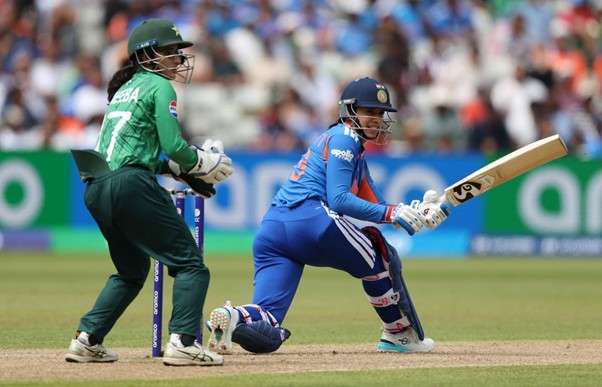
The scorecard will show that India defeated Pakistan by 64 runs at Edgbaston on Sunday to kick off their 2026 ICC Women’s T20 World Cup campaign in style. It will be noted that India posted a formidable 170, but a brilliant knock from Smriti Mandhana was overshadowed by Deepti Sharma, who ran through the opposition with an extraordinary five-wicket haul. But what the bare numbers fail to capture is the distinct aroma of panic that floated over the Birmingham ground during the first four overs of the afternoon.
Opting to bat first, India’s blueprint for a high-tempo start was instantly torn to shreds. Shafali Verma fell in the very first over, playing too early at Sadia Iqbal to be dismissed for just six. When Jemimah Rodrigues was deceived by World Cup debutant Tasmia Rubab a couple of overs later, India were tottering at 18 for 2. The pitch was two-paced, the ball was holding in the surface, and the early summer clouds were offering the seamers just enough lateral movement to cause real structural distress.
India desperately needed someone to absorb the pressure of a high-stakes derby. Through an impeccably calculated, 44-ball 68, Smriti Mandhana did not just rescue the innings; she laid down the tactical base that allowed India to completely dictate the tempo of the entire match.
Match Overview & Smriti Mandhana’s Impact
| Match Component | Details |
| Tournament | 2026 ICC Women’s T20 World Cup (Match 6 of 33) |
| Fixture | India Women vs Pakistan Women |
| Venue | Edgbaston Stadium, Birmingham, United Kingdom |
| Result | India Women won by 64 runs |
| Top Scorer | Smriti Mandhana (68 runs off 44 balls) |
Navigating the New-Ball Squeeze
To appreciate the true genius of Smriti Mandhana’s knock, you have to understand how hard she had to work during the initial phase of her innings. Often categorized as a batter who thrives purely on the momentum of a rapid Powerplay, Smriti Mandhana had to suppress her natural instincts entirely.
Alongside skipper Harmanpreet Kaur, who played a characteristically gritty anchoring role with 36 off 35, Mandhana accepted that the boundary ropes were out of reach during the initial exchange. Pakistan’s spinners bowled exceptionally tight lines, dragging their lengths back and targeting the stumps. India crawled to a conservative 38 for 2 by the end of the Powerplay their lowest six-over aggregate against Pakistan in recent times. At that moment, Mandhana was scratching around on a highly uncharacteristic run-a-ball score, visually battling her timing on a sticky deck.
The Smriti Mandhana Knock Metrics
| Metric | Performance Details |
| Runs Scored | 68 |
| Balls Faced | 44 |
| Strike Rate | 154.55 |
| Boundaries | 9 Fours, 2 Sixes |
| Key Partnership | 91 runs off 63 balls (with Harmanpreet Kaur) |
| Innings Split | First 24 Balls: 27 Runs (SR: 112.50) | Next 20 Balls: 41 Runs (SR: 205.00) |
Tactical Acceleration and Structural Value
The turning point of the entire Indian innings arrived in the ninth over. On 27, Mandhana top-edged an ambitious sweep off Nashra Sandhu, only for deep square leg to misjudge the trajectory and put down a sharp chance. In tournament cricket, giving an elite player a second life is like suicide. Mandhana treated the reprieve not as a warning, but as a green light to alter her hitting arcs.
What followed over the next ten balls was pure batting theater. Recognizing that off-spinner Rameen Shamim was bowling with too much air, Mandhana repeatedly danced down the track, converting good-length deliveries into half-volleys and lofting them inside-out over extra cover. The elegance was classic Mandhana, but the intent was entirely new. She required just 10 more deliveries after her drop to bring up a majestic half-century off 34 balls, completely breaking the defensive fields Fatima Sana had carefully constructed.
This structural platform allowed the rest of the dugout to play within their defined niches. By taking on the mantle of the primary aggressor, she allowed young finisher Richa Ghosh to walk out in the death overs and play with absolute freedom. Ghosh’s explosive, unbeaten 17-ball 34, which included taking 23 runs off Tasmia Rubab in a critical penultimate over, simply could not happen if Mandhana hadn’t already broken the spirit of the Pakistani bowling changes.
Also Read: IND vs PAK: Deepti Sharma’s All-Round Show Crushes Pakistan