
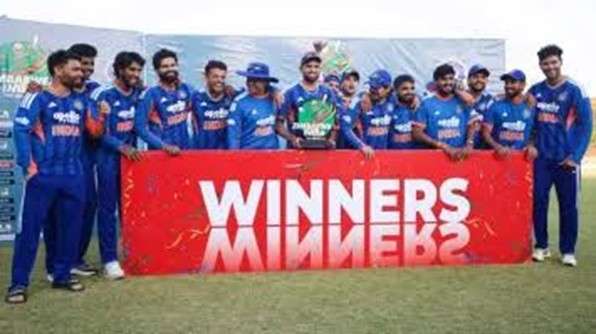
After disappointing tours of England and Ireland, India’s young brigade found its rhythm in Zimbabwe. A six-match losing streak is enough to shake the confidence of any cricket team. For India, consecutive T20I series defeats against England and Ireland raised serious questions about the team’s adaptability, batting approach and ability to perform in challenging overseas conditions. The Men in Blue looked a shadow of themselves, struggling to find momentum as critics questioned whether the ongoing transition phase was beginning to take its toll.
However, when India arrived in Zimbabwe, the narrative began to change. Under the leadership of Shreyas Iyer, India produced a fearless brand of cricket, sweeping aside Zimbabwe with aggressive batting, disciplined bowling and sharp fielding. More importantly, the series showcased a group of players eager to seize their opportunities and restore India’s winning identity.
A Fresh Start After a Difficult Phase
After the defeat from England and Ireland exposed several concerns. India’s batters struggled to cope with seam movement and bounce, partnerships were hard to come by, and the bowling attack often lacked consistency at crucial moments. The team that had dominated T20 cricket suddenly looked vulnerable.
Rather than dwelling on those setbacks, the Indian camp treated the Zimbabwe tour as an opportunity to reset. The result was a side that looked confident, expressive and far more decisive in its execution.
Young Stars Rise to the Occasion
One of the biggest positives of the series was the emergence of Vaibhav Sooryavanshi. The 15-year-old announced himself on the international stage by smashing his maiden T20I half-century in just 19 balls, becoming the youngest player to score a men’s T20I fifty. Vaibhav’s fearless approach in the opening match set the tone for India’s campaign and immediately established him as one of the country’s most exciting young prospects.
The youngster backed up that performance in the final T20I with a composed 81 off 49 balls, proving that his first outing was no flash in the pan. His ability to absorb pressure and dominate the bowling attack reflected a maturity well beyond his age.
Another major success story was Ishan Kishan, who reminded everyone of his match-winning ability in the second T20I. His explosive 81 off 44 deliveries earned him the Player of the Match award as he dismantled Zimbabwe’s bowling attack with a fearless display of power-hitting. Alongside him, Tilak Varma provided the finishing touch with an unbeaten half-century, ensuring India crossed the 200-run mark.
Pace Attack Delivers the Perfect Response
In the opening T20I, Mayank Yadav made an immediate impact by dismissing Zimbabwe opener Brian Bennett with the very first ball of the match, setting the tone for the innings before finishing with two wickets. Prince Yadav matched that effort with a disciplined two-wicket spell, while the bowlers collectively restricted Zimbabwe to 125/7.
The momentum continued in the second match as debutant Yash Thakur impressed with two wickets, Prince Yadav maintained his consistency, and Abhishek Sharma cleaned up the middle order with a three-wicket haul. In the series finale, Mayank Yadav once again led from the front with three wickets, while Yash Thakur added two more, underlining the depth of India’s pace attack.
A Statement Beyond the Scoreline
The Zimbabwe series was about much more than three victories. It marked a shift in mindset.
After enduring six consecutive defeats, India responded not with caution but with confidence. The youngsters embraced responsibility, and Shreyas Iyer’s calm leadership brought the best out of the squad.
For India, Zimbabwe became more than just another tour—it became the stage where confidence was rebuilt, new stars emerged, and a team searching for answers rediscovered its winning.
Also Read: ZIM vs IND: Shreyas Iyer’s Brigade Derails Zimbabwe