
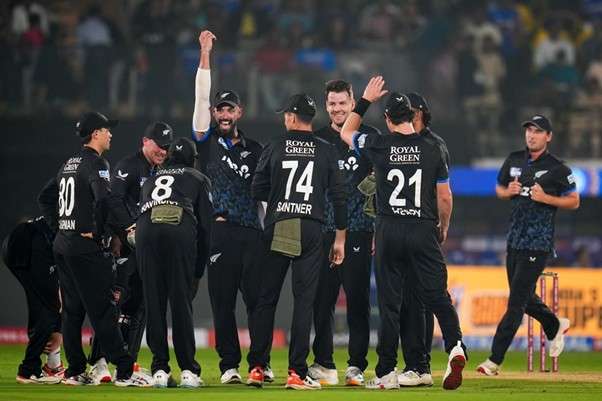
New Zealand will look to once again punch above their weight when they compete for the ICC T20 World Cup 2026 in India and Sri Lanka. New Zealand who are the most consistent side in ICC events have not won an ICC event for quite a while barring the WTC success in 2021. New Zealand have been there in there about reaching the knockout stage barring the 2024 edition where they flopped and exited in group stage only. Since 2024, they have had a mixed bag in the T20 format.
With players coming and going, New Zealand have found the going tough in the shortest format of the game. They are now well led by Mitchell Santner after the retirement of Kane Williamson from this format. They lost 1-4 in the recently concluded series against India but found some positives while they beat West Indies 3-1 lately. Against Australia and England they lost the series in rain affected games. The Kiwis reached the finals in 2021 while lost in the semis in 2022. They reached the semis in 2016 as well. But they have failed to cross the final hurdle.
Here, in this article we will emphasise on the strengths, weaknesses, opportunities and threats of Team New Zealand a team that is liked by all due to their on-field behaviour. They are the nice guys of the tournament.
Strengths
- Balanced and Experienced Squad: New Zealand’s 2026 squad blends seasoned campaigners with in-form performers, giving them tactical depth across formats and match situations. Players like captain Mitchell Santner, Ish Sodhi, and all-rounders such as Glenn Phillips, Michael Bracewell, and Rachin Ravindra provide control, flexibility and match winning potential. This makes them really strong and can perform under pressure.
- Spin-Friendly Arsenal: With multiple spin bowling options like Mitchell Santner, Ish Sodhi, Rachin Ravindra, Glenn Phillips, and Michael Bracewell, New Zealand is well equipped to exploit the slower, spin assisting subcontinental conditions in India and Sri Lanka especially in venues like Chennai that traditionally help spin bowling. New Zealand will be playing 3 of their 4 group matches in Chennai and could benefit from the squad they have chosen.
- Strong Batting Depth: A mix of aggressive hitters like Finn Allen, Glenn Phillips and stabilising batters like Devon Conway and Daryl Mitchell gives the team the balance. New Zealand can adapt to defending totals or chasing competitive scores, making them resilient in varied match contexts. This shows their adaptability according to the situation of the game.
- Variety in Bowling: The bowling attack for New Zealand blends pace and variation as they have fast bowling options like Lockie Ferguson, Matt Henry, and promising swing from Jacob Duffy that compliments the spin bowling options, making them capable of attacking both in early overs and in the middle overs as well. This blending can really prove to be the trump card for New Zealand.
Weaknesses
- Injury & Availability Concerns: Key bowlers have recently returned from injuries, and paternity leaves could disrupt balance. Heavy reliance on a relatively small pool of seamers means injuries could force role reshuffles at crucial moments which will not be ideal for the team. New Zealand have a limited talent pool and so major injuries could hinder them in these events.
- Powerplay Inconsistency: While New Zealand have aggressive openers, they sometimes struggle to assert dominance in the powerplay. In T20s where early scoring sets the platforms for big totals, inconsistency at the top can leave a lot of pressure on the middle order. The likes of Finn Allen and Tim Seifert can be hit and miss and that could be an issue for New Zealand in big games.
- Over–dependence on Key Contributors: The squad’s strength often hinges on a handful of all-round performers. If the core batting or the bowling leaders falter under pressure, the team could struggle to maintain momentum against strong opponents. This could be a key deterant as they do not have a big squad depth like other sides. So, if the main players fail, then New Zealand could stutter a tad against the big teams.
Opportunities
- Subcontinental Conditions Advantage: Preparation tours and warm-up series in India ahead of the World Cup offers real-time acclimatisation to the conditions which in turn gives them a tactical edge over teams that are arriving later. Familiarity with pitches and conditions is a critical asset for New Zealand and it is something New Zealand can use and drive home the advantage.
- All-Rounder Flexibility: Possessing multiple multi-dimensional players allows New Zealand to adapt their playing XI combinations based on pitch and opposition, something that could be decisive in group stages and later on in knockout stages. The flexibility could help New Zealand going forward especially in close games.
- Dark Horse Status: Placed in a competitive pool that includes South Africa and Afghanistan, New Zealand have the chance to upset higher-ranked side and build momentum. Their experience in ICC events means they often perform above expectations. They have the dark horse status and that will help them punch above their weight against the teams in a tough group.
Threats
- Tough Group Stage: New Zealand are in a tough group in Group D and will face strong sides like South Africa and Afghanistan and that could make early tournament progression challenging. A slow start could force reliance on net run rate and add the pressure on subsequent matches. New Zealand have to be at their best to qualify to the Super 8s as taking the foot guard could be detrimental.
- Pressure of Expectations: With a long World Cup drought in T20s and past near misses, the mental pressure of knockout cricket could impact performance, especially in crunch games where a single collapse can de decisive. The pressure could get to them and that is a big threat for the Kiwis.
- Opponents‘ Firepower: Several teams in the tournament boast deeper batting firepower or more explosive pace options. If New Zealand’s key players don’t fire simultaneously, they could be outgunned in high-scoring contests. The opponents could be too much to handle and that is a big threat for the Kiwis going forward as well.
New Zealand T20 Squad for World Cup 2026
Mitchell Santner (c), Finn Allen, Michael Bracewell, Mark Chapman, Devon Conway, Jacob Duffy, Lockie Ferguson, Matt Henry, Daryl Mitchell, Kyle Jamieson, James Neesham, Glenn Phillips, Rachin Ravindra, Tim Seifert, Ish Sodhi.
Travelling Reserve: Ben Sears.
The Journey Ahead for New Zealand in World Cup 2026
New Zealand have had a decent run coming into the World Cup and although they lost the series 1-4 to India in India, they got acclimatised to the conditions on offer before the mega event and also fine tuned their skills as well. New Zealand have been placed in Group D also known as the Group of Death which includes top teams like South Africa and Afghanistan. The Kiwis have a warm up game on 5th February against USA in the evening.
Then they start their Group D campaign on February 8th in Chennai against Afghanistan in a morning game. Then they face UAE on 10th February in the afternoon also in Chennai. Then they go to Ahmedabad to face South Africa on 14th February in the evening. They finish their group stage campaign against Canada on 17th February in a morning game in Chennai.
New Zealand have a tough group and will have to be at their best to go to the super 8s. If they reach the Super 8s, we feel they have the team to reach the semi-finals. So, a semi-final finish is what we think New Zealand will achieve. But once you reach the semis, it’s all on the day and who knows a trophy could be on their way.
Let’s see how the team performs in the T20 World Cup 2026.
Also Read: ICC T20 WC 2026: 2-Time Champions West Indies Aims To Win Record 3rd Title