
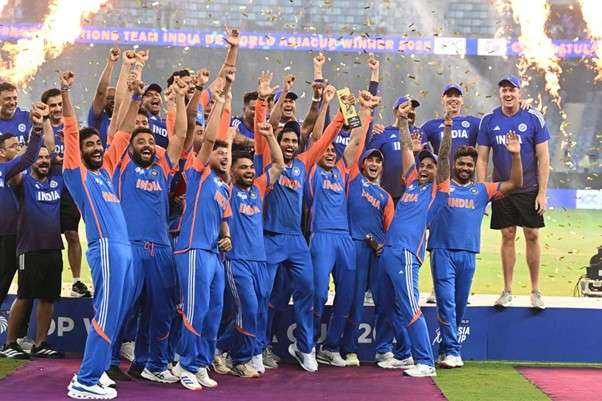
Two-time reigning defending champions India will look to create history as they embark on their possible third T20 World Cup trophy. India under Suryakumar Yadav has been in red hot form and to many experts and pundits look like the team to beat on paper. But as we know, nothing is won on paper as you still have to go out there and perform as a unit. India has been in form and have played a different brand of cricket no doubt compared to other teams, but that does not guarantee a title win as the process and steps have to be followed in winning the tournament.
Since the 2024 triumph, India has not lost a bilateral T20I series under Suryakumar Yadav. They may have lost an odd match here and there but have won everything coming their way. Whether playing at home or away, India have bagged the series easily. They beat Sri Lanka in Sri Lanka, Bangladesh, South Africa in South Africa, England at home, Asia Cup undefeated in September-October. They won a series in Australia before lately beating South Africa 3-1 and New Zealand 4-1 both at home ahead of the World Cup.
With every team, it cannot be all strengths and no weaknesses at all. There are chinks in the armour that India will have to be wary and aware of as most teams have their loopholes somewhere or the other. In this article, we will talk about the strengths, weaknesses, opportunities and threats of Team India.
Strengths
- Unmatched batting depth: There is unmatched batting depth in Team India. The Men in Blue can field around 8-9 genuine batters. This will include explosive openers like Abhishek Sharma and Ishan Kishan while there is an adaptable middle order and power finishers like Tilak Varma, captain Suryakumar Yadav, Hardik Pandya, Rinku Singh, and Shivam Dube to name a few which gives flexibility on any surface.
- Elite all-rounders: India possesses multi-skill players that allow balance in the team without compromising batting or bowling, a huge edge in T20 cricket. The likes of Hardik Pandya a pace bowling all-rounder and Axar Patel the vice-captain of the team are huge assets for Team India. Add Shivam Dube in the mix who has improved as bowler and batter, and India seems to have all bases covered.
- High- quality spin attack: India have a high quality spin attack with wrist spinners like Varun Chakaravarthy and Kuldeep Yadav in the ranks alongside finger spinners like Axar Patel and Washington Sundar who is recovering from an injury but on the comeback trail right now as we speak. These spinners provide control and wicket-taking options especially in the middle phase of the game.
- Big match experience: Most players representing this Indian side are battle-hardened playing in the Indian Premier League and other global tournaments which generally will reduce pressure in the knockouts. Some of these players majority of them in fact were part of the 2024 campaign and so if put into pressure situations, they can come out of it with flying colours because of the experience.
- Strong bench strength: India has a strong bench strength in general as injuries or loss of form don’t necessarily derail their plans. The replacements are often international quality. A team which has no place for Yashasvi Jaiswal or Shreyas Iyer alongside no guaranteed first XI place for Kuldeep Yadav shows the bench strength and quality of this Indian team.
Weaknesses
- Death bowling inconsistency: This is a concern that is there with Team India despite the change of template for them. Closing out innings under pressure is a concern especially against elite finishers. We have seen in some matches that the bowlers leak runs in the death overs like Arshdeep Singh, Harshit Rana and even Jasprit Bumrah as well. They have been up and down and it is the cushion or volume of runs that’s helped India win. Pitches are flat, but India will hope and need to get their death over bowling right and consistent.
- Overdependence on top order: There is overdependence on the top order of India as early wickets can still expose the middle order to scoreboard pressure. There seems to be an overdependence on Abhishek Sharma to give the team great starts as that makes it easier for others. But if he gets out, India could struggle to repair things under pressure. They have the players, but do they have the temperament remains to be seen.
- Knockout match nerves: Knockout match nerves is something that can haunt even this powerful Indian team. The recent ICC events show that there could be a pattern of underperforming in semi-finals and finals. India won the 2024 T20 World Cup and 2025 Champions Trophy but before that they lost a lot of finals and semi-finals in 2023 ODI final, 2022 T20 semi-final, 2019 ODI semi-final, 2017 Champions Trophy final to name a few as India had a ICC title drought after 2013 Champions Trophy drought till the triumph in 2024 T20 World Cup.
- Frequent leadership or combination changes: Too much rotation and chopping and changing of sides can affect the clarity of roles close to the tournament. Experimentation is fine up to a point, but overdoing it could lead to confusion although there is talk of flexibility and adaptability in the team, but it could create confusion and chaos in the team which can be a potential threat to the team.
Opportunities
- Clear role definition before the World Cup: If India settles in on a stable playing XI and fixed roles then that can unlock peak performance for the team. Role clarity is important for a side and if the side knows their role even with adaptability and flexibility they will have an idea as to how to go about the innings which can help India do well.
- Emergence of fearless young talent: New age players of India bring talent, athleticism, and unpredictability. These players are fearless and carry no baggage within them which gives them the opportunity to shine and they are given freedom by the management to express themselves. Individual milestones don’t matter for these players, team score and intent matters a lot.
- Conditions Awareness: India are playing at home and are well aware of the conditions. Their extended exposure to sub-continent pitches and hybrid pitches as well gives strategic advantage. The Indians have the opportunity to make teams and combinations according to the conditions on offer and pick it accordingly. They don’t have to chop and change too much and make horses for courses changes.
- Tactical evolution: Data driven match-ups and flexible batting orders can maximize strengths. There is tactical evolution as lot of match-ups and data are involved and the team management pays attention to it like left-hand right hand combination, match-ups against the spinners, among many help strategize better and the team performs better with these match-ups.
Threats
- Injury workload management: A packed calendar increases burnout risk for key players. This could be a threat as key players due to burnout may either get injured or lose form which can cause trouble for India. So, managing workload in bilateral series is essential for these players to remain fresh for the World Cup.
- Rising competition: India might be the team to beat and have most bases covered but there are other teams in the fray like Australia, England, West Indies alongside emerging nations that are tactically sharp and fearless in their approach. In the Super 8s or beyond, India might have to face their fearlessness and have to be on top of their game to come out on top and win the games.
- Spin neutralising batting line-ups: Some opponents are now well equipped to counter spin heavy attacks. India is a spin heavy attack for sure and if teams in knockouts go after it and neutralise the middle overs phase which is India’s strength or has been their strength, then the Men in Blue can struggle to compete and may well lose a match. India needs to be mindful of these teams going after them.
- Pressure of expectations: Being tournament favourites by most experts adds to the psychological pressure and weight in the crunch games. The pressure of expectations from a billion people could weigh down the Indian team and whether they are fearless in batting will remain to be seen there. Everybody expects India to go all the way and as players that is a huge pressure to carry and can become one of the most important external threats for the team in their campaign.
India Squad for T20 World Cup 2026
Suryakumar Yadav (c), Abhishek Sharma, Tilak Varma, Sanju Samson, Shivam Dube, Ishan Kishan, Hardik Pandya, Arshdeep Singh, Jasprit Bumrah, Harshit Rana, Varun Chakaravarthy, Kuldeep Yadav, Axar Patel, Washington Sundar, Rinku Singh.
The Journey Ahead for India in World Cup 2026
India have been in red-hot form lately and like already mentioned unbeaten in bilateral series since the 2024 triumph and Asia Cup 2025 win as well. The T20 side looks to have most bases covered and barring a bad day in knockouts, India could be hard to stop. They have played lot of T20 games ahead of the World Cup and seems to have got their roles cleared. They beat New Zealand 4-1 in the last T20I series before World Cup after beating South Africa 3-1 last year.
India faced South Africa in the only warm up games for both teams ahead of the tournament in Navi Mumbai where India posted 240 runs on the board with most batters spending time in the middle with Ishan Kishan and Tilak Varma doing well while South Africa posted 210/7 in reply with them also getting a hit. It was a good warm up as India won the contest by 30 runs.
The focus turns to the World Cup as the 2-time defending champions are placed in Group A and will play all their games in the evening hours from 7 PM IST. India starts their campaign against USA on 7th February in Mumbai before taking on Namibia on 12th February in New Delhi. They then have to take the flight to Colombo where they are scheduled to beat arch rivals Pakistan in the greatest rivalry on 15th February where the match has been in the news for all the wrong reasons. India will finish their group stage campaign against Netherlands on 18th February in Ahmedabad.
Looking at the group stage, India should sail past that with Pakistan being the only real challenge for them in the first round. If preseedings follow its course, then India will be in a tough Super 8 group alongside Australia, South Africa, and West Indies. India has to play well and perform to go through as win is no guarantee. Saying so, with the team India has they should manage and find a way to reach the semis. So, reaching the semis should not be too much of an issue and then it’s all about who plays well on the day in the semis.
So, we reckon a semi-final finish is minimum for Team India with the team likely to go all the way if things fall into place. But there are other teams who will look to stop this Indian team. A quick reminder, no team has defended the title successfully alongside winning a home T20 World Cup as well. No team has won this tournament 3 times yet. These are the three things India wants to change. Let’s see how things pan out and how the hosts India carry the billions hope and perform under pressure.
Also Read:Â ICC T20 WC 2026: Ireland Looks To Roar In High Voltage Tourney