
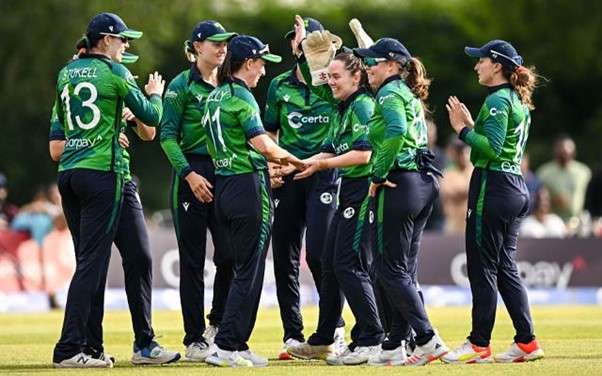
Gaby Lewis’s progressive, youth-driven team enters the 2026 T20 World Cup having missed out on the last edition and trending from competitive underdog to genuine giant-killer after qualification via Kathmandu and wins over Pakistan and the West Indies in the build-up. The late withdrawal of Ireland‘s former captain and veteran all-rounder Laura Delany radically shifts their tactical calculations. Below is an elite-level, data-backed SWOT breakdown of Ireland’s structural profile heading into Group 2.
Ireland’s Squad for 2026 T20 World Cup
Gaby Lewis (C), Amy Hunter (Wk), Orla Prendergast, Arlene Kelly, Rebecca Stokell, Leah Paul, Aimee Maguire, Cara Murray, Louise Little, Alice Tector, Lara McBride, Alana, Dalzell, Sarah Forbes, Jane Maguire, Freya Sargent.
1. Strengths (S) – Dynamic Top Order and Swing Proficiency
Despite their lack of tournament experience relative to tier-one nations, Ireland possess highly specialized physical and technical assets that perfectly match the conditions of an early-summer English tournament.
-
Elite Top-Three: In Gaby Lewis, Amy Hunter, and Orla Prendergast, Ireland boasts an international-class top order. Lewis acts as a high-volume anchor (276 runs at the Global Qualifier). Hunter provides flexible wicketkeeper-batter utility with a high intent profile, while Prendergast is an elite, multi-dimensional enforcer capable of altering momentum through raw power down the ground.
-
English-Condition Optimized Pace Unit: Led by Arlene Kelly, the bowling unit excels at lateral movement and hard-length discipline. Kelly’s ability to extract seam and swing (highlighted by her match-winning 4-7 against Thailand and extensive local knowledge) makes the new ball a serious weapon under overcast UK skies.
-
Tactical Spin Variance: Left-arm orthodox spinner Aimee Maguire and leg-spinner Cara Murray provide excellent angle variations, allowing Ireland to implement field-restriction bowling strategies that don’t rely solely on pace.
2. Weaknesses (W) – Leadership Vacuum and Middle-Order Instability
The structural floor of this squad is compromised by an absence of experienced depth, a flaw that elite opposition analysts will heavily target.
-
The Laura Delany Structural Deficit: Delany’s tournament-ending injury removes nearly 100 T20Is of tactical experience. Her absence deprives the middle order of a reliable crisis manager and takes away a crucial medium-pace resource capable of holding an end dry during the middle overs.
-
Severe Lower-Middle Order Volatility: If Lewis, Hunter, or Prendergast are dismissed within the Powerplay, Ireland’s scoring velocity historically drops. While Rebecca Stokell has shown upside (such as her unbeaten 60 against Pakistan), the middle-to-lower order (Leah Paul, Louise Little, and rookie Alice Tector) lacks proven tracking metrics when it comes to chasing heavy totals against elite death bowling.
-
Deficit in Specialist Domestic Exposure: As Captain Gaby Lewis openly acknowledged, Ireland lacks a mature, fully professionalized domestic provincial structure. Consequently, young players like Lara McBride or Alana Dalzell are forced to undergo their technical development directly at the international level against world-class opposition.
3. Opportunities (O) – Local Conditions and Group Scheduling
The tournament’s logistical and environmental setup plays directly into Ireland’s tactical strengths if they execute cleanly.
-
Familiar Pitch and Weather Profiles: Having played extensive cricket in similar conditions, Ireland’s batters understand the technical demands of playing late-afternoon fixtures in England, specifically playing with late hands against swing. Their seamers will not need an adjustment period to find the correct fuller lengths.
-
Group 2 Scheduling Leverage: Ireland opens their campaign against Scotland at Old Trafford. Securing an explicit victory in this match allows them to build psychological momentum and put massive NRR pressure on intermediate group members like the West Indies or an unpredictable Sri Lankan side.
-
Tactical Powerplay Maximization: Because outfields like Bristol and the Hampshire Bowl offer clean, consistent bounce, stroke-makers like Prendergast can exploit the field restrictions early, forcing tier-one teams into defensive, deep field sets early in the innings.
4. Threats (T) – Spin Chokes and Tactical Isolation
The margin for error in Group 2 is very thin, and structural flaws can be easily exposed by clinical opponents.
-
The Big Three Threat: Elite teams (specifically England and New Zealand) will employ hyper-targeted matchup strategies to isolate Ireland’s top order. If defensive spin options strangle Lewis and force Prendergast to hit against the spin toward the long boundaries, Ireland risks stalling completely in the 7-14 over bracket.
-
The Fielding Issue: In high-octane T20 matches, ground-fielding efficiency routinely decides outcomes. Ireland’s young unit has occasionally leaked extra runs via poor boundary-riding and dropped catching opportunities. Against clinical line-ups, surrendering a life to elite batters will completely break their bowling plans.
-
Slow Over-Rate Operational Costs: Lacking an experienced on-field general like Delany, there is an increased risk of communication delays when resetting fields. If Ireland falls behind the over-rate clock, being forced to bring a crucial boundary fielder into the inner circle during the death overs will be severely punished.
Ireland Women – Group 2 Schedule
| Match # | Opponent | Date (2026) | Venue | Start Time (IST) | Tactical Analytical Note |
| 1 | Scotland | June 13, Saturday | Old Trafford, Manchester | 15:00 IST (10:30 Local) | Critical opening fixture. Ireland must leverage new-ball swing to disrupt the Bryce sisters early. |
| 2 | England | June 16, Tuesday | Hampshire Bowl, Southampton | 23:00 IST (18:30 Local) | High-exposure night fixture. Testing the young top order’s technical footwork against heavy local swing. |
| 3 | New Zealand | June 19, Friday | Hampshire Bowl, Southampton | 23:00 IST (18:30 Local) | Tactical middle-overs battle. Speed variations from Irish spinners will be key to restricting the White Ferns. |
| 4 | Sri Lanka | June 23, Tuesday | Bristol County Ground, Bristol | 19:00 IST (14:30 Local) | High-stakes encounter. Strategic focus will center heavily on creating boundary-dry matchups against Chamari Athapaththu. |
| 5 | West Indies | June 27, Saturday | Bristol County Ground, Bristol | 19:00 IST (14:30 Local) | Group stage closer. Ireland’s pace execution must contain death-over baseline hitters like Dottin and Henry. |
Analytical Prediction
Ireland’s 2026 World Cup campaign will likely stall in the group stage due to a critical structural imbalance. While they possess a world-class frontline engine in Gaby Lewis and Orla Prendergast, alongside a seam attack highly optimized for local English swing conditions, the late injury withdrawal of Laura Delany introduces a fatal tactical deficit.
Laura Delany’s absence creates an inexperienced middle-order vacuum that elite, tier-one spin attacks will ruthlessly exploit during the crucial 7-14 over consolidation bracket. Without her proven strike rotation and anchor utility to absorb pressure, Ireland will struggle to maintain scoring velocity against sophisticated defensive choking strategies, ultimately leaving them mathematically short of a semi-final berth.
Also Read: ICC Women’s T20 WC 2026: Defending Champions New Zealand Hopes To Retain Its Crown