
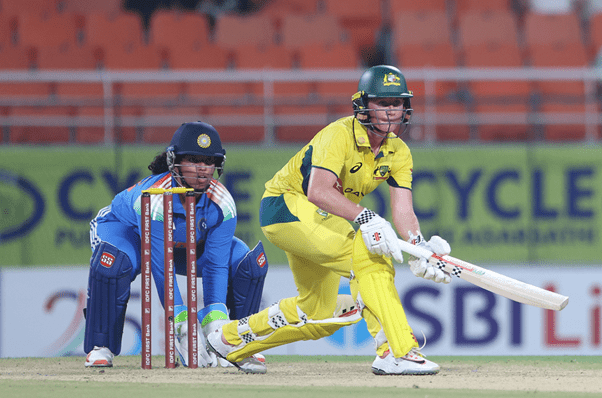
India Women crashed to a comprehensive 8-wicket defeat at the hands of reigning champions Australia in Mullanpur. The Women in Blue were good in patches, but showed rustiness and faltered in the key moments. And against Australia, one cannot falter anywhere. There were positives for India, but there were gaping holes that India needs to address ahead of the marquee tournament, like the Women’s World Cup starting on 30th September 2025. Here, we will list out three reasons for their loss against Australia in Mullanpur.
Multiple dropped catches cost India the match
India posted a competitive 281 on the board but they knew it was not a winning score as Australia have tremendous depth in their batting. So, it was important that India created chances and held onto any catches that came their way. They did create chances alright but the catches were dropped and India were left to rue what might have been for them.
The most beneficiary of them was Player of the Match Phoebe Litchfield. She was first dropped when she was on 0 by Jemimah Rodrigues off Sneh Rana. Then she completed her half-century was batting on 56 when Harmanpreet Kaur the captain put her down at covers region to give her another life. She eventually made 88 off 80 balls and turned the game on its head. That’s not all. Ellyse Perry was dropped by Pratika Rawal when she was on 20 and she made 30 before going off the field retired hurt. Beth Mooney who made an unbeaten 77 was dropped by Deepti Sharma which was another sitter earlier on in her innings.
4 catches dropped against a quality side is not acceptable and multiple players being dropped. Australia obviously took advantage of it and won the contest in a canter. Looking ahead, India must improve their ground fielding and catching by leaps and bounds if they want to compete against big sides like Australia. Otherwise, more disappointments will await the Women in Blue as we look forward to bigger things ahead for them.
Lack of variety in bowling resources hurt India
India went into this game with 4 spinners and one pacer and no other option. The mantra that worked in England did not quite work here. Going in with 4 spinners meant India were perhaps compelled to bat first and hoped that in the second innings it will help the spinners. But that was not to be as the pitch played true throughout. Playing with 4 spinners, we felt maybe India should have opted to chase as the spinners may have got some purchase in the afternoon, but it was not to be.
Playing with 4 spinners meant that with dew forming, the spinners struggled to grip the ball, and India had only one pacer to fall back on. That became a handicap, and it was easy going for the Australians. The spinners had an off day and lacked control, but credit to Australia for playing them so well. India has Renuka Singh Thakur and Arundhati Reddy in the bench, but they played Kranti Goud in this game as the lone pacer. Plus, only 5 bowlers were used by India, which meant they had no options to go to others.
Compare that to Australia, which used as many as 8 bowlers and shows a plethora of options they have. One can say India are playing to their strengths by playing these many spinners. Going forward, for a better balance, India should play 2 pacers and 3 spinners as that will be a balanced attack in these conditions. The pitch was docile and came onto the bat easily. India needs variety as the bowling attack that played yesterday lacked that and was uni-dimensional in nature.
Slowing down in the middle phase between 21-30 pegged India back
India started well through their openers Smriti Mandhana and Pratika Rawal as the duo put on 114 for the first wicket with both scoring elegant half-centuries. But against the run of play, Mandhana fell for 58 and the scoring rate suddenly dropped as Australia tightened the screws. Suddenly, the boundaries dried up as India went through a phase of runs in singles without many boundaries.
In the first 20 overs, they did decently but slowed down in the phase between 21-30 where despite losing one wicket they could score only 36 runs. This was a big moment in the game as Harleen Deol and Pratika Rawal struggled and took time to settle together as a partnership. Deol later kicked on and scored a half century at a fair clip. But this 10-over phase hurt India because in ODIs against Australia, every phase is important. Getting 36 runs for the loss of one wicket might have cost India 20-30 extra runs which Kaur mentioned in the presentation.
If we compare that to Australia, they scored 58 runs in the 21-30 phase for the loss of one wicket. So, if one looks at it in isolation just this phase, we will find that Australia have scored 22 runs more than India and are ahead of the rate. These little things matter in ODIs against the big nations and India must be mindful of that. Going ahead in this series and beyond, India needs to capitalize on the good start by the openers and get to 300+ which is a bare minimum against this Australian side and challenge them. 280-290 isn’t going to challenge the reigning champions on this docile pitch.
What Lies Ahead
Australia are 1-0 ahead in this 3-match series after a dominant win in the first ODI on Sunday. Both teams will next meet on Wednesday, 17th September 2025 at the same venue with the match slated to start at 1:30 PM IST. Australia will look to be dominant and seal the series on Wednesday while India will look to bounce back and level the series at 1-1 before both the sides go to New Delhi for the 3rd match.
Will the Aussie dominance continue against India? Or will the Women in Blue fight back against the Aussies. We will find all the answers on Wednesday when we get closer to match action.
Also Read:Â IND-W vs AUS-W: Phoebe Litchfield & Beth Mooney Decimate India