
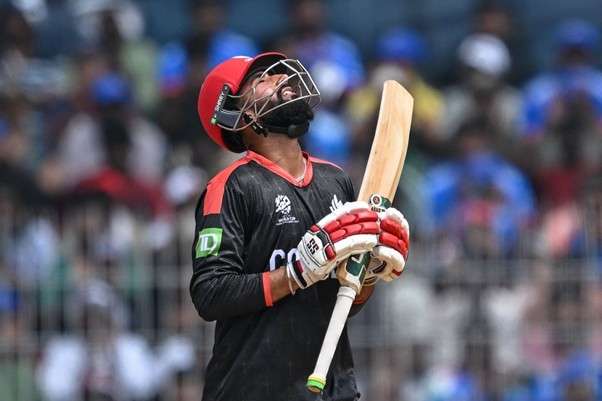
Canada put up a large score of 173/4 in their 20 overs after they batted first against New Zealand at the MA Chidambaram Stadium in Chennai during the ICC Men’s T20 World Cup 2026, held on February 17th, 2026, and then went on to record their first win in T20I’s at an ICC World Cup competition. The innings of Canada was highlighted by an extraordinary innings of an unbeaten 100 by Yuvraj Samra, 19 years old, who became the youngest centurion in T20 World Cup history at 19 years and 141 days and also the first centurion from an Associate nation in T20 World Cup history.
Canada Launch Phase(1-6 overs)
Yuvraj Samra (opener) and Dilpreet Bajwa (captain of Canada) created an excellent platform for Canada in the powerplay as they faced New Zealand’s fast bowling attack consisting of Matt Henry and Jacob Duffy. They were both able to deal with the movement of the ball in the early stages of the innings and then built their partnership in a steady manner.
In the final over of the powerplay, James Neesham’s bowling was taken apart by Samra, who smashed four boundaries and a six to bring his score to 29 runs off only 17 balls. Along with Samra, Bajwa scored 20 runs off 19 balls to contribute to an unbeaten partnership of 50 runs after the 6th over of the innings, which is one of the best starts by Canada in the tournament and has set a very aggressive, yet controlled, tone.
Canada Consolidation Phase (Overs 7-13)
After the powerplay, Canada’s focus was to keep on building upon their momentum by continually rotating strike. Samra pushed the pace, scoring 50 in 36 balls (the youngest to score 50 in T20 World Cup history at this point of time); and his 116-run opening stand with Bajwa (36 off 39) for the first wicket established the record for any Associate team against a Full Member for any partnership in T20 World Cups.
Both spinners (Cole McConchie and part-time bowler Glenn Phillips) were hit for back-to-back sixes by Samra in the 13th over; and Samra lost a batting partner when Bajwa (caught by Glenn Phillips off Kyle Jamieson) was dismissed in the 14th over to end the marathon first wicket partnership, but Samra remained as the bedrock.
Canada Acceleration Phase (Overs 14-17)
Following his success with the bat, Samra’s performance went from good to amazing. He got his first international hundred in T20 cricket from 58 balls, and became the first-ever batter from the Associate nations to get a hundred at the ICC T20 World Cup. Navneet Dhaliwal also contributed with a rapid 10 runs off 7 balls (which included a six), but it was Samra’s big hitting—mixing pulls, drives and lofted shots—that were the biggest force in producing an explosive run-rate of 116 to 150 in just four overs (14th to 17th) toward the end of the innings.
His powerful stroke-making enabled him to hit a significant number of boundaries and sixes (including a six that Matt Henry dropped) off the almost 80m boundary back in Australia.
Canada Finish Phase (Overs 18-20)
Wickets and drama marked the end of the match, with James Neesham dismissing Nicholas Kirton lbw with a successful appeal to the third umpire and Matt Henry cleaning up Dhaliwal with a catch to Phillips. Despite Samra’s late innings dominance, he was caught by Phillips off Jacob Duffy for an incredible 110 runs from 65 balls (11 x4 6 x6) in the second last over.
Dilon Heyliger blasted six runs from his very first ball and ended up with 8 runs from three balls, while Harsh Thaker chipped in with quick runs as Canada scored a further 10 runs in the last over for an overall score of 173/4. New Zealand’s bowlers, Duffy (1 for 25) and Neesham (1 for 38), managed to contain some of the run scoring, but could not completely stop the flow of runs. Samra’s remarkable innings was an outstanding combination of maturity and power, allowing Canada to post a completely defendable total at a venue that usually produces wickets and leaving New Zealand an uphill battle with what could be a potential upset.
Also Read: ICC T20 WC 2026: Pathum Nissanka’s Brilliant Ton Knocks Australia