
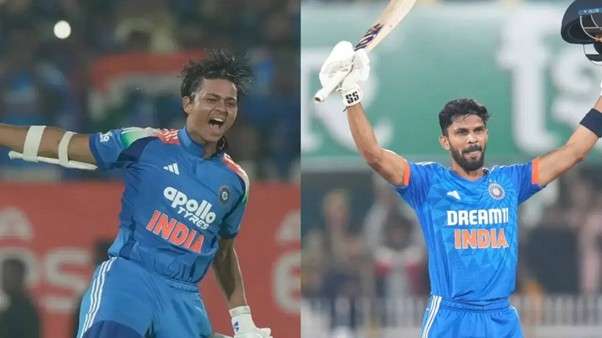
There is a distinct, almost unmerciful reality to the modern Indian selection meeting. Just hours after Yashasvi Jaiswal walked off the Chepauk turf with an unbeaten, match-winning 110 against Afghanistan, his reward was not a plane ticket to London with the 50-over team, but an immediate relegation to the T20I setup. When the BCCI announced the 15-man squad for the upcoming three-match marquee assignment in England, the absolute omission of Yashasvi Jaiswal and Ruturaj Gaikwad from the ODI squad stood out like a sore thumb.
For Yashasvi Jaiswal, it feels like an existential cricketing paradox: he now has two hundreds in his first six ODI appearances, yet he cannot get into a 15-member squad. For Ruturaj Gaikwad, the situation is perhaps even more frustrating. Despite a mountainous appetite for runs in domestic cricket and an elegant technical blueprint built for the 50-over game, he finds himself captaining an India A side in Sri Lanka & even won the tri series but got ignored for England series.
This isn’t an indictment of their talent; it is the ultimate byproduct of a generational structural squeeze. As India structures its roadmap for the 2027 World Cup, the return of the old guard has forced the selectors to pivot from experimental stage back to hardened international stability.
The Cold Arithmetic of India’s Top Three
To truly understand why Ajit Agarkar’s committee chose to leave out two of the most prolific young run-scorers in the country, you have to look at the rigid hierarchy of India’s top order. The squad configurations for the English tour leave zero room for alternative accumulation.
| Player | Strategic Role in England | Tactical Impact on the Roster |
| Shubman Gill (c) | Opening Batsman & Captain | The designated anchor and leader of the transition era. |
| Rohit Sharma | Opening Batsman | The veteran enforcer providing explosive Powerplay starts. |
| Virat Kohli | Number 3 Anchor | Returning from a hamstring layoff to hold the tactical spine together. |
When you realize these three positions are completely non-negotiable, the logic behind the omission of Yashasvi Jaiswal and Ruturaj Gaikwad from ODI squad becomes starkly clear. Neither Jaiswal nor Gaikwad are middle-over operators who can walk out at number five or six to manipulate the old ball and clear the ropes at death. They are specialized, rhythm-dependent top-order players. Carrying them in a tight 15-member traveling squad to England simply to sit on the bench makes little developmental sense when those slots can be utilized for multi-phase bowling depth.
The Backup Keeper Variable: Why Ishan Kishan Broke the Door Down
The other significant roadblock for the young opening pair has been the resurgence and tactical utility of Ishan Kishan. Recalled to the mix against Afghanistan, Kishan didn’t just score runs; he smashed a blistering 125 in Lucknow in 2nd ODI that completely reset his stock value.
| Roster Component | Selection Dynamics & Tactical Utility |
| Primary Keeper |
KL Rahul (Locked at No. 5): Provides the structural spine to the middle order, acting as the primary wicket-keeper and a reliable stabilizer during the middle overs. |
| Backup Keeper Utility |
Ishan Kishan (Can open or bat at No. 4): Offers immense tactical flexibility due to his left-handed dynamic profile. His ability to double up as an explosive option at the top or float into the middle order makes him an invaluable asset on the bench. |
| Tactical Consequence |
Carrying an extra specialist opener like Jaiswal or Gaikwad becomes a luxury India cannot afford. With the top three positions non-negotiable and Kishan covering multiple roles, carrying single-skill backup openers limits the multi-phase bowling depth required in a tight 15-member traveling squad. |
Ishan Kishan provides the selectors with a vital safety valve. If Rohit Sharma or Shubman Gill pull up lame, Ishan Kishan can seamlessly step into the opening slot as a left-handed explosive engine. If a middle-order batsman misfires,
his left-handed dynamic profile can slide into the middle overs. Because Yashasvi Jaiswal and Ruturaj Gaikwad do not offer that structural versatility or wicketkeeping coverage, they became the casualties of a numbers game.
Looking Ahead: The 2027 Transition Map
While it is easy to view this selection as a step backward for the youth movement, the reality is far more calculated. The team management is clearly prioritizing localized specialization for the 2026 calendar year. Yashasvi Jaiswal is being primed as the undisputed crown jewel of India’s Test and T20I transitions, while Ruturaj Gaikwad remains the definitive leader-in-waiting within the shadow programs.
Tactically Managing the Workload
By leaving them out of the grueling 50-over segment in England, the BCCI medical and selection teams are also subtly managing the volume of cricket these players absorb. With five T20Is against England right after the ODI leg and a massive home Test winter on the horizon, shielding Yashasvi Jaiswal from a format where he would likely sit on the bench ensures his technical battery remains fully charged for the assignments where he is an automatic starter.
Discussion on India’s squad for England ODI series:
Verdict: A Necessary Cruelty
Ultimately, analyzing the omission of Yashasvi Jaiswal and Ruturaj Gaikwad from ODI squad highlights the immense, almost frightening health of India’s talent pipeline. In any other cricketing ecosystem, a young batsman coming off a flawless, match-winning century under heavy pressure would be the first name on the team sheet.
But India is currently operating on a dual-timeline strategy balancing the ultimate twilight runs of Rohit Sharma and Virat Kohli with the gradual blooding of the next generation. It is a harsh, necessary piece of short-term planning. Yashasvi Jaiswal and Ruturaj Gaikwad will undoubtedly have their day in the 50-over sun, but for now, they must wait for the old guard to finish writing their final chapters before they can truly claim the keys to the kingdom.
Also Read: ENG vs IND: India Announces 15-Man Squad For ODIs