
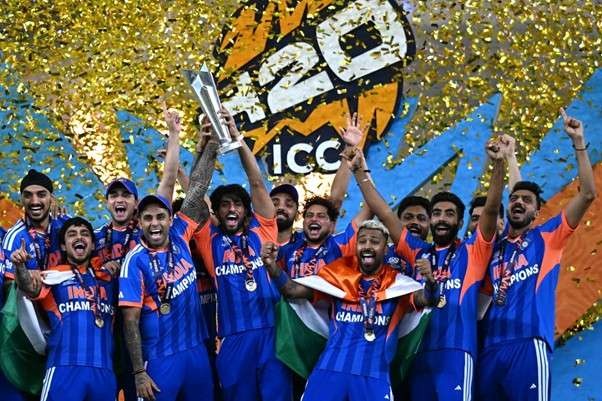
The tenth edition of the T-20 World Cup 2026 was played in India and Sri Lanka. It was a fierce and energetic tournament, which saw a total of 20 teams that fought neck and neck for the most precious trophy. T20 is a fast-paced format where players should be able to think on their toes. This format is like a nightmare for bowlers due to flat pitches, high-scoring games, and the short boundary length.
T20 has a long and rich history because, as a format that was started in 2005, it eventually gained traction and massive support, especially from the younger crowd. Until the early 2000s, cricket was played at a slow pace with the red ball, i.e. test matches being the priority for most, but in the middle of 2005, a new format emerged that grabbed several eyeballs.
The first-ever T20 match was played between Australia and New Zealand in 2005, with Australia winning. It was a one-off T20 game at Auckland, but soon after, T20 cricket became popular, and it was watched as entertainment. So far, there have been ten editions of the T20 World Cup, and each edition has brought zest and excitement. The level of play has risen, with high risks and greater rewards.
India’s Journey throughout the 10 editions of the T-20 World Cup has seen highs and extreme lows, starting with the 2007 World Cup in South Africa, which was the inaugural season but proved to be a massive step in the format’s popularity in India. The 2007 T-20 World Cup immediately brought in the grand IPL, which made India the powerhouse of T20 cricket.
Research
2007: World Champions led by a Rookie MS Dhoni –
The 2007 team was full of youngsters, and the BCCI had excluded the likes of Sachin Tendulkar, Rahul Dravid, VVS Laxman, and Sourav Ganguly. It was a big call to exclude the experienced players and instead play young and raw talent, but the plan never backfired as MS Dhoni became the first Asian captain and the first Captain to win a T20 World Cup.
Back then, the concept of a super over was non-existent; however, to make the match spicy, the concept of a bowl-out was decided. In a bowl-out, the teams are given five chances to knock off the stumps and the team that hits the stumps the most without missing is declared the final winner. When India took on the arch-rivals Pakistan in a group stage match, the match was initially declared a tie, but the bowl-out saved India. Robin Uthappa, Harbhajan Singh, and Virender Sehwag hit the bullseye, whereas the Pakistanis missed every opportunity.
2007 World Cup saw a glimpse of Rohit Sharma, a 20-year-old raw talent who later won the T20 World Cup as a captain and became one of the greatest white-ball player of the generation. Rohit Sharma scored a crucial 50 from 40 balls in the match against South Africa, winning the game for India.
Batting at number seven, Rohit remained not out and formed a crucial 120-run partnership with the captain, MS Dhoni. From being in a perilous state, Rohit’s knock ensured that India crossed 150, and Rohit also earned POTM for his valiant knock.
India lifted the first-ever T20 World Cup, defeating Pakistan in the final. Who can forget those golden words by Ravi Shastri on the commentary, “in the air and Sreesanth takes it. India wins!” What was more surprising was that India won without the big names; Tendulkar, Dravid, Laxman, and Kumble, all of whom opposed this new format, were later impressed by the achievement of a young Indian team.
The 2007 World T20 victory was a stepping stone for the future of T20 cricket in India, but after winning the inaugural World Cup, India’s T20 trophy cabinet was empty until 2024. It had a lot of attempts, but all failed. It would not be wrong to say that since the inception of the IPL, it took India another 17 years to end the trophy drought.
IPL: A life of glamour and stardom –
The 2007 T20 World Cup triumph gave a massive push and boost to the T20 format in India. The crowd preferred and enjoyed the sixes and the concept of ‘small scores but huge impact’, and this left a lasting impression, which enabled the inception of a new T20 league in India.
Back in 2008, Lalit Modi, the founder of the IPL, came up with this brand new concept, which was fun, fast, and short. The IPL, over the years, has transformed the careers of many, especially the youngsters. The IPL provided a kick to the shorter format and promoted it.
The IPL eventually became the most successful tournament in India. Apart from this, it is also a platform for the upcoming generation to shine and show their skills. Players like Prithvi Shaw, Shubman Gill, Jaiswal, or even Vaibhav Suryavanshi busted out in the big scenes through the IPL.
Not only the youngsters, but also some of the greats and experienced players, such as Sachin Tendulkar, Sourav Ganguly, Rahul Dravid, Matthew Hayden, Andrew Symonds, Gilchrist, and Kevin Pietersen, have also played in the IPL. In fact, the inclusion of senior players gives a great opportunity for the junior and raw talent to learn from them.
India’s Attempts and Shortfalls after 2007
After the 2007 triumph, India made several attempts towards the trophy, but every time it was outdone by the opponent team, and India’s journey ended on a sour note.
2014 final: So near yet So Far
India fell short of being the favourites in the 2014 T20 World Cup. Following a disastrous T20 World Cup campaign in 2009, 2010, and 2012, India had another shot at the trophy, but this time it was a rampant Sri Lanka that crushed it in the final.
The 2014 T20 World Cup in Bangladesh saw the rise of Virat Kohli, who led the runs chart. Virat Kohli scored 319 runs throughout the World Cup and also led India into its second T20 World Cup final after defeating South Africa. Kohli scored four half-centuries in that World Cup at an average of 106 in six games.
The semi-final against South Africa was a career-defining moment for King Kohli. He remained not out, scoring 72 from 44 balls, winning the match for India and taking them into their second T20 World Cup final and their fifth overall ICC men’s final. MS Dhoni, known for his selfless approach, let Kohli finish the game in the last over.
In the final against Sri Lanka, India only managed 129, which was a below-par score and considering Sri Lanka’s form throughout the World Cup and their approach, they easily chased the target, with Kumar Sangakkara smashing a brilliant 52. It was a fitting farewell to the Sri Lankan legend as Sri Lanka won the final.
2016 T20 World Cup: Virat Kohli vs World
After the drubbing in 2014, India had another chance to make it count, and this time the T20 World Cup was hosted in India, ultimately making India the strong favourites to lift the trophy. It was a one-man show because Virat Kohli was dominating the home World Cup with 273 runs in five matches. Kohli was the highest scorer for India and the second highest behind Tamim Iqbal in the World Cup.
Some of Virat’s stellar performances came against arch-rivals Pakistan at Kolkata and Australia at Mohali. India was in deep trouble, losing three wickets at the front, and Kohli’s knock was a much-needed stabiliser. Kohli scored 55 from 37 balls against Pakistan. That T20 World Cup saw a different Kohli altogether; he was a beast, smashing and setting records.
Highest average in the World Cup, most fifties for India and most fifties in the World Cup, 2016 was Virat Kohli’s year in general; from IPL to test cricket to T20, he truly owned it. He scored a total of 641 runs in 13 T20 matches.
Kohli’s knock against Australia at Mohali silenced everyone. It was a major reason behind the team’s survival in the World Cup. It was a do-or-die game for the hosts, but Kohli not only walked the walk but also talked the talk, scoring 82, which saved India from humiliation. This was Kohli’s second half-century of the tournament. The T20 World Cup in 2016 was literally Virat against the rest of the teams; he was the man of the series in that World Cup, but India lost yet again in the semi-final against the West Indies.
2024 T20 World Cup Triumph: A blueprint for 2026
The 2007 Victory paved the way for the future, while the 2024 T20 World Cup win in the West Indies and the USA was a redemption that set the tone for the 2026 World Cup in India. The planning for the World Cup in the West Indies and the USA began two years before. In fact, after the T20 World Cup in Australia, India regrouped and prepared for the 2024 T20 World Cup.
2022 World Cup in Australia was disastrous for Rohit Sharma and Rahul Dravid as India was hammered brutally by England in the semi-final. India lacked aggression, and Rohit, in the post-match, emphasised being aggressive in this format. Since the 2022 World Cup, Rohit has taken responsibility upfront by providing explosive starts, and his tactics have done wonders for the team.
Rohit’s approach reaped great rewards for the team in the 2024 T20 World Cup, which India won after 17 years. Rohit emphasised more on strike rate than individual performances, and the matches against Australia and England were a perfect example where the Indian captain took on the bowlers by the scruff of their necks. Against Australia, Rohit targeted Mitchell Starc in the third over, belting 29 runs off the over. This flattened the Aussie bowlers, giving India a massive win, and the curse of 19th November was finally broken.
Rohit leads with the bat –
Rohit Sharma, Indian captain in the 2024 T-2o world cup was the highest run-scorer in the tournament, with 257 runs in eight matches. His memorable and most crucial performances were in the semi-final against England and against Australia. Rohit scored a brisk 57 in the semi-final, showing dangerous intent and aggression.
Two years ago in Australia, England hammered India in the semi-final, but, more importantly, it capitalised on India’s safe and defensive approach. This time, it was the complete opposite as India’s aggressive intent in T20 was led beautifully by skipper Rohit Sharma. India demolished the 2022 semi-finalists comprehensively.
Revenge of Ahmedabad in St. Lucia –
The 2023 ODI World Cup final left the Indian fans and the cricket team heartbroken and in despair, but in the T20 World Cup against Australia, India settled the scores of the final. It was Rohit Sharma again who dismantled the Australian pacers. Rohit lashed out at every bowler and spared nobody. He eventually missed a deserving century, but the damage was already done. Rohit’s outrageous 92 from just 41 balls ended Australia’s World Cup.
That night was special for every Indian, especially for Rohit Sharma and his emotions were seen through his brutal knock. Rohit hit a record eight sixes in that match, which showed how emotional and frustrated he was about losing to Australia. India scored 205 after 20 overs, and yet again, Travis Head caused a little scare, and it felt as if he would drive Australia home again, but this time, he failed.
It was like a complete circle for Rohit as he grabbed Head’s catch off the bowling of Jasprit Bumrah, and India marched on into the final of the T-20 World Cup for the third time.
Home World Cup: Glory and Nostalgia
The 2026 T20 World Cup in India took viewers down memory lane as it was the first T20 World Cup in India since 2016. This time, India was the firm favourite because it was the current champion of the format. Winning the 2024 T20 World Cup in the West Indies laid a foundation for the 2026 World Cup, and the transition occurred smoothly after the retirements of Virat Kohli, Rohit, and Jadeja in 2024.
The baton was passed on from Rohit Sharma to Suryakumar Yadav, and the experience from SKY, Axar, Bumrah, Arshdeep, and Dube helped those who were playing their maiden World Cup. New coach Gautam Gambhir and captain Suryakumar Yadav had a brilliant partnership throughout the World Cup. Gautam fed all his experience to the younger players and made important but strategic changes in the team.
Winning the World Cup at home was relatively easy for India after winning the 2024 edition. The 2024 edition had an emotional story associated with it, as after a drubbing in the 2022 T20 World Cup, where India lost badly to England in the semi-final, Rohit Sharma and Rahul rewrote the entire script.
Heading into the World Cup in the West Indies and the USA, India changed its approach. From playing conservative and safe cricket, India played aggressive and unpredictable cricket, and Captain Rohit took the entire onus upon himself to slam from the word go. Thus, the same approach was seen in the 2026 T20 World Cup.
India’s aggressive approach paid off extremely well, and the talent it produced, especially after the retirement of legendary cricketers in the T20 format, was exceptional. At a time when everyone thought that transition in the T20 team would be difficult, India proved them wrong. The opening pair of Abhishek Sharma and Sanju Samson was a perfect mixture of ice and fire that India needed. Ishan Kishan provided stability in the middle order.
Ishan Kishan was the man in form in the home World Cup. In his first ICC tournament, Kishan amassed 317 runs at a strike rate of 193. Kishan was only behind Sanju Samson. Kishan, although, was not the man of the tournament; his impact was huge. Batting at number three and replacing one of the legends in Kohli, who made that position almost his home, Kishan took that responsibility and thrived even when the going was tough. He delivered a big knock 25-balls 54 in the final against New Zealand, which was a big factor in India posting more than 250 in the final.
19th November put to Rest
8th March 2026 was a statement to 19th November 2023. India killed the Ahmedabad demons and permanently put that feeling to bed with an emphatic victory on the same ground that gave them a sorrowful memory against Australia in the ODI World Cup final. The format might have been different, but the emotions and the result were different as well. India is now the only team to defend its title.
2026 T20 World Cup victory was a team performance
Every player contributed equally throughout the World Cup. Sanju and Ishan Kishan were in a purple patch, leading run-scorers for the team. Suryakumar held the innings together in the first match against the USA, scoring 84 from just 50 balls, which lifted the team’s score. The Wankhede pitch was slow, and batting first, India wobbled, losing three wickets for just 46 runs, but Surya’s calm approach and sensible knock ensured that the men-in-blue reached a formidable score.
In the bowling department, Siraj and Arshdeep landed the final nail in the coffin. Siraj had three wickets to his name while Arshdeep picked up two. USA showed great fight throughout the match, especially Shadley Schalkwyk picking four wickets, but the slowness of the surface made it difficult for the batsmen to free their arms easily.
India got a crucial win in the first game and set the ball rolling. Surya’s knock with the bat and Siraj’s magic with the ball kept the Americans below 150. Surya was awarded the player of the match for his batting. Next up was Namibia, which was a walkover given India’s batting strength and overall depth.
Mountain of Runs against Namibia
The pitch against USA was difficult, yet India did better than worse; although the pitch used against Namibia at Delhi was a belter, and the Indian batsmen enjoyed batting. A load of runs were scored by India in the first innings on the back of explosive knocks from Ishan Kishan and Hardik Pandya. Hardik Pandya scored a 28-ball half-century that included four sixes and four boundaries, while Ishan Kishan scored 61 from just 24 balls at a strike rate of 254.
Namibia did well to curb further damage, but they crumbled during the run-chase to spin wizard Varun Chakravarthy, who picked three wickets in two overs. Varun bowled in good areas, leaving the batsmen puzzled, and Axar Patel lent support from the other end. It was a pure masterclass in spin bowling by Chakravarthy, who has been a huge asset for India since the Champions Trophy 2025.
India won by a huge margin of 93 runs. It was the most complete and dominant display by the team in the entire World Cup as it prepared itself for the mega clash against Pakistan. To have every player performing rather than relying on an individual was the missing piece of the puzzle that the captain and coach found after the game against Namibia.
India vs Pakistan: Where Emotions speak before the game
The rivalry between India and Pakistan is well-known around the cricket globe, and the two nations meet only during a mega sporting event like the World Cup. India has a massive upper hand over Pakistan in T20 cricket with 13 wins, while 7 wins in T20 World Cups.
This time the scenario was the same. India played Pakistan at a neutral venue in Colombo, but the men in green were further down after a loss against India as Opener Ishan Kishan thrashed the Pakistan bowlers to bits and pieces. Ishan’s knock of 77 included 10 boundaries and three sixes. He scored his half-century in only 27 balls, toying with the Pakistan attack. Kishan had an 87-run partnership with Tilak Verma, changing the course of the game.
175 in 20 overs seemed to be enough for the Pakistan batting, which was without its regular keeper Mohammad Rizwan. Babar Azam failed, captain Salman Ali Agha failed terribly, and Usman Khan was the lone warrior. India wrapped up Pakistan with two overs to spare, asserting its dominance over the arch-rivals and moving closer to the playoffs.
South Africa humbles the hosts
The loss against South Africa was important to stay grounded. After winning four matches on the trot and maintaining a superlative run-rate, the team went back to the drawing board. The Indian team was not at its best at Ahmedabad. After having the Proteas at 167 for 7, they let the game slip away with power hitting from Tristan Stubbs, David Miller and Dewald Brevis. India’s batsmen had no answer to Marco Jansen as he picked up four wickets, giving India a 76-run defeat.
Zimbabwe Blown away
Zimbabwe was a walkover for the team. Gambhir and Suryakumar did extremely well in holding the squad together and forgetting the previous match. India scored the highest score of the tournament, 256, on the back of monstrous hitting by Hardik Pandya, who scored 50 off 25 balls, including four sixes. Abhishek Sharma and Tilak Verma complemented Hardik to up the score.
Brian Bennett played a lone hand of 90 runs, and Zimbabwe lost by 72 runs. Arshdeep Singh picked up three wickets at an economy of six. India’s campaign was back on track, and it had to play one last game to qualify for the Semifinals. India next played against West Indies, and we all know what happened in that game.
Redemption for Sanju Samson: India vs West Indies
Before the match against West Indies, there were doubts raised about Sanju Samson’s form. He was suffering from an injury that kept him in and out of the team, and his inconsistent scores were the main reason for him being left out. West Indies scored 195 in the first innings, but Samson started the chase positively, slamming 14 runs off Akeal Hossain’s over. How fitting was it for Sanju to remain unbeaten and take India into the semi-finals. Sanju missed a deserved century but got a huge monkey off his back after that knock.
He ended the tournament as the highest scorer for India, the third-most in the World Cup. With 321 runs in five games and a strike rate of nearly 200, Sanju Samson was the man of the tournament.
England gives a scare, but India sails through.
The semi-final against England was a nail-biter. India scored 253 on yet another flat deck. It was probably below-par after England started off the chase. Jacob Bethell took on India’s bowlers to all parts of the ground, leaving them in shackles. Samson was the only one standing between India and victory, but a run-out on the last ball gave India the win, and all were relieved.
Sanju Samson was again the man of the match for his outstanding 89. Jacob Bethell’s mind-blowing century failed to overshadow Sanju’s efforts, but Bethell won many hearts that night. India overcame the English challenge at Wankhede and stepped into its fourth T20 final. The stage was set; Ahmedabad was the venue for the final between India and New Zealand.
ICC T20 WC 2026 Final
The Narendra Modi Stadium, Ahmedabad, was set to feature India and New Zealand in the final of the T20 World Cup 2026. Both teams had had contrasting campaigns before reaching the final, New Zealand more so, with losing two games to England and South Africa. As far as India was concerned, there was no prior loss or things to repair, but the catching and fielding were still to improve.
New Zealand bowled first, and India started with the same intention. Sanju Samson and Abhishek Sharma had a great partnership up the order as they gave a good start to the team. The top three for India were in great rhythm in the World Cup. Ishan Kishan, Sanju, and Abhishek were the top three run-scorers in the World Cup for India.
The top three batters’ scores for India in the final were 89, 52, and 54, respectively. In the end, New Zealand crumbled under pressure, folding for 159, handing India the largest win of the tournament, 96 runs. Samson was the player of the series for his outstanding contribution. The dream of Surya and Gambhir was achieved as India became the only team to win consecutive ICC trophies.
Glorious campaign for India
This was India’s campaign in the recent T20 World Cup. India has vast depth and talent in every format, and with regard to T20, there are youngsters and stars like Vaibhav Suryavanshi, Yashasvi Jaiswal, Ravi Bishnoi, Gurnoor Brar, and many more who have the potential to play for India and be match-winners. The next T20 World Cup is in four years, and India’s vast talent pool will play a huge part in Australia and New Zealand.
The previous T20 World Cup was a batsmen’s paradise where the bowlers did not have much say. In spite of this, Jasprit Bumrah and spinner Varun Chakravarthy finished as the top two wicket-takers for India in the T20 World Cup 2026. Chakravarthy had 14 wickets in nine games with an average of 20.50, whereas Bumrah had figures of 14 wickets in 8 matches at an average of 12.43. He also had one four-wicket haul against New Zealand in the final.
Also Read: ICC T20 WC 2026: India’s Journey To Ultimate Glory