

Today was a clinical display of resilience as part of the One-Day International series, where home-ground dominance was on full display as the Bangladesh national cricket team delivered a commanding performance to secure a historic 55-run victory over the New Zealand national cricket team. This win in the third and final ODI of the 2026 bilateral series, held at the Zahur Ahmed Chowdhury Stadium in Chattogram on 23 April 2026, ensured a 2-1 series victory for the hosts. The match served as a masterclass in tactical adaptation; Bangladesh posted a competitive total of 265/8 in their allotted 50 overs despite early pressure, with the innings shaped by crucial middle-order consolidation.
After suffering a narrow 26-run setback in the opening match in Dhaka, the Tigers recalibrated their approach to sweep the remaining fixtures. This turnaround was defined by a sophisticated batting effort along with a disciplined bowling blueprint that frequently left the New Zealand side searching for answers. As the final wicket fell, the celebration marked more than just a match win; it signalled Bangladesh’s growing maturity in managing high-pressure situations and highlighted their ability to execute plans effectively against a well-balanced New Zealand side. This result further confirms Bangladesh’s continued evolution into a premier force in the 50-over format.
Najmul Shanto Hossain’s ton stuns Kiwis
The Bangladesh team’s first innings was defined by resilience, confidence, and immense clarity, alongside calculated risk-taking. The final ODI began with a high-stakes decision as New Zealand’s captain, Tom Latham, won the toss and elected to bowl first, hoping to exploit the early morning moisture.
The hosts were immediately put under immense pressure as New Zealand’s disciplined new-ball attack extracted movement and control. Consequently, the Bangladeshi top order was decimated within the first nine overs. However, rather than allowing the innings to unravel, the middle order stepped up. New Zealand’s opening bowler, Will O’Rourke, was the architect of this early destruction, dismissing Saif Hassan, Tanzid Hasan, and Soumya Sarkar.
The home side looked vulnerable and in danger of a series-defining collapse. However, when the middle order stepped in, they absorbed the pressure while ensuring the scoreboard continued to tick. A 180-run partnership was forged between Najmul Hossain Shanto and Litton Das.
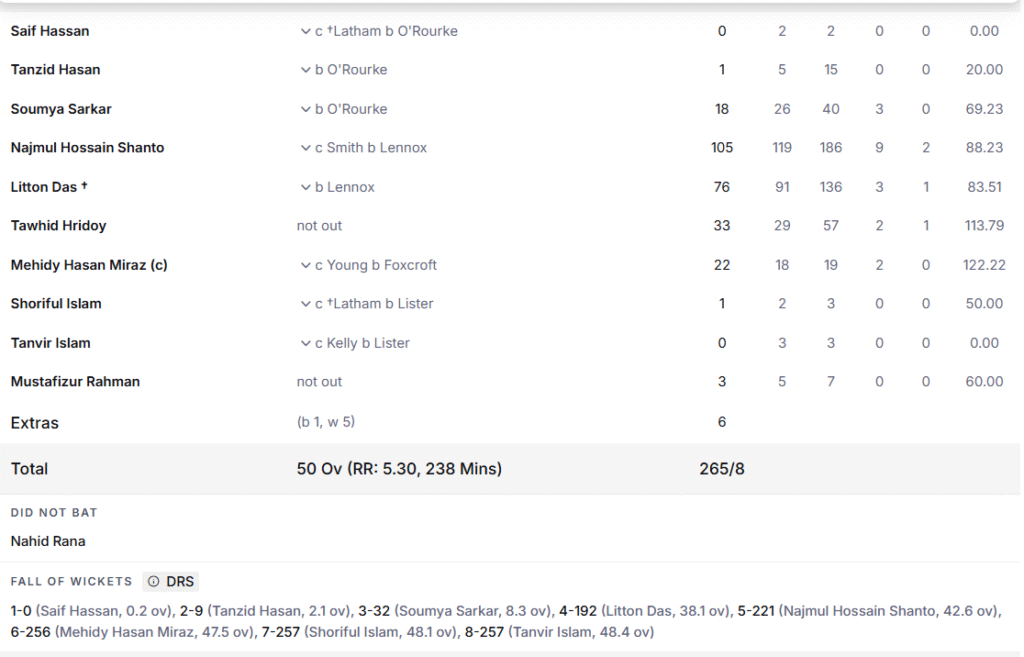
Shanto anchored the innings with a masterfully composed 105 off 119 balls, acting as the cornerstone of the lineup, while Das provided the perfect foil with 76 off 91 balls. Both batters showed commendable game awareness, rotating the strike effectively against the spinners and capitalizing on loose deliveries to rebuild momentum before Das was eventually deceived by Jayden Lennox’s spin.

As the innings progressed, this platform proved invaluable. Tawhid Hridoy then added 33 off 29 balls to ensure a strong finish. Bangladesh eventually concluded their 50 overs at 265/8 – a total that challenged the New Zealand side and highlighted a collective intent and adaptability, as the team revived itself from a top-order collapse to structure an innings that maximized output across all phases.
Mustafizur Rahman’s 5 wicket haul seals series
Team New Zealand walked onto the field tasked with chasing 266 for a series victory, but their second innings never gathered the sustained momentum required to seriously challenge Bangladesh’s total. The hosts executed a disciplined, confident, and well-structured bowling performance; while the visitors began with aggressive intent, they ultimately collided with Bangladesh’s relentless spin and seam discipline.
The New Zealanders started cautiously against the new ball, with the Tigers’ seamers maintaining tight lines and extracting enough assistance from the surface to limit scoring opportunities. Nick Kelly and Will Young provided a steady start; however, the introduction of Mehidy Hasan Miraz sparked a stunning collapse, triggering a sequence of wickets that the New Zealand middle order was unable to halt.
While there were brief moments where the batters attempted to counterattack and shift the momentum, the Bangladeshi bowlers responded effectively by striking at crucial moments. As the afternoon progressed, the pitch at Chattogram began to offer significant turn and uneven bounce, favouring the home side.

Mehidy Hasan Miraz then dismantled the middle order, picking up the crucial wickets of Tom Latham and Jayden Lennox in quick succession and controlling the run flow to create constant scoreboard pressure. While Dean Foxcroft showed some resistance with 75 off 72 balls, he found little support from the other end.
Forced into taking higher risks to bring the game back in their favour, the New Zealand lineup faltered further. The final blow came with the return of Mustafizur Rahman; New Zealand’s last three wickets fell for just 5 runs, and they were eventually bundled out for 210 in 44.5 overs.

Ultimately, Bangladesh’s 55-run victory in Chattogram serves as a resounding validation of their white-ball credentials. This victory reflects a complete, disciplined, and well-executed performance across all three departments, where they showed greater composure, adaptability, and tactical clarity than their opponents. They demonstrated immense psychological resilience, and Najmul Hossain Shanto was rightfully named Player of the Match for his match-winning century, which anchored the performance and brought the team closer to their win.
New Zealand, despite showing glimpses of resistance and rhythm, was unable to piece together the kind of partnerships required in a chase of such a competitive nature, ultimately falling short under immense pressure. This series loss exposes a lingering vulnerability to high-quality spin on slow-turning tracks – a concern the team must address quickly to avoid repeating the same mistakes in future matches.
What lies ahead
The focus now shifts toward the shortest format of the game; for Bangladesh, this result not only secures a strong finish to the series but also reinforces their growing confidence and ability to deliver in decisive moments. Meanwhile, New Zealand will have to reassess key areas on the field. If the intensity of this ODI series is any indication, both sides are transitioning into a high-octane environment for the upcoming T20I matches.