
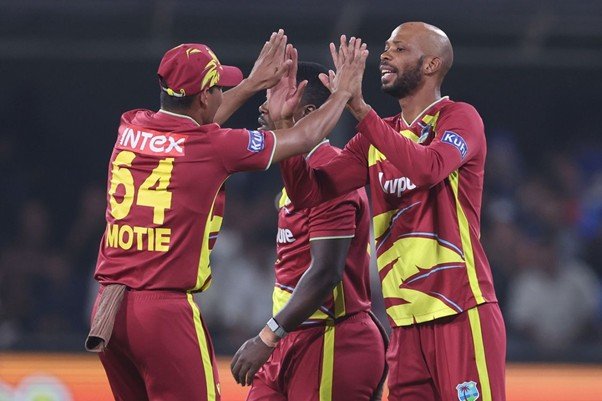
Riding high after a record run chase in Ranchi, West Indies were given a reality check and a wake-up call by India, as the Men in Blue showed that a total can be defended in this series. At the Holkar Stadium in Indore, India produced an inspired bowling display under pressure to hold West Indies to 14 runs short and take a 2-1 lead in the 5-match series. India played the crunch moments better and won key phases that helped them close out the match. There are areas where West Indies lacked, and we shall decipher them for you.
Conceding 87/1 in the powerplay pushed West Indies on the back foot
West Indies won another important toss and decided to chase, as is the norm in the series. The visitors started well as they got rid of Sanju Samson early and had India under check after 2 overs. But then the floodgates opened as the visitors’ bowlers were unable to contain the left-handed duo of Abhishek Sharma and Ishan Kishan. The duo counter-attacked and took the game away from the West Indies in a blistering partnership. Abhishek was the star, but Ishan played his game as well.
The duo made sure that India amassed 87/1 in the first 6 overs in order to get a head start in the innings. Abhishek scored a cracking half-century while Ishan played a useful cameo as the duo put on a match-winning 108-run stand for the second wicket in a mere 40 balls. This laid the platform for India. Credit to the West Indies for roaring back and keeping India to 223. But the damage was done, as on a black soil wicket with no dew, the target was more challenging than it seemed.
In the end, India held their nerves for the win. West Indies, for the second game in a row, bowled badly in the power play, as in Ranchi they had given away 79/1 in 6 overs. The power-play bowling is the bane for the Men in Maroon, and they have to sort that out and bowl better if they want to level the series in a decider. Yes, power play is hard when the batters are set, but better planning and execution are needed from the West Indies bowlers’ point of view.
Shai Hope’s rare failure with the bat dented the run chase significantly
Chasing 224 for a 2-1 series lead, West Indies were hoping for a solid start and a quick one at that. The visitors had a lot of dependence and hope on Shai Hope, their talismanic captain and keeper-batter who had done no wrong in this series so far. But after all, he is a human, and the law of averages was bound to catch up with the batter. That is exactly what happened in Indore. Tasked with a chase of 224, Hope was overhitting the ball and managed to hit a boundary before being cleaned up by Arshdeep Singh. This was a huge moment in the game, and it gave renewed hope to India to defend the score.
Thereafter, Kamil Pooran went at around a run a ball before accelerating towards the end, while Shimron Hetmyer looked good after being given a reprieve on 5* as he made 43 before being cleaned up by Naman Dhir. But the Hope wicket meant West Indies were playing catch-up and made only 54/1 in 6 overs of the powerplay in the chase of 224. India were 87/1, and so 33 runs was the difference between the two sides at the end of the power play. This was significant with no dew around, and it was too much to do for the West Indies.
West Indies needs to find better ways of combating the power play, especially with the early departure of Hope, and their dependence on him has to be reduced a little bit. Yes, they did well to breach the 200-run mark despite his low contribution, but still some work to do for the visitors if they want to challenge India and become a better team. Depending on individuals takes the team up a little bit, but up to a point. They don’t take you to the sky. West Indies needs to work on this aspect.
Tactical decisions like pushing Roston Chase down to Number 9 exposed West Indies’ management
There were a few tactical calls made by West Indies team management which raised a few eyebrows for sure. Firstly, while bowling, West Indies captain Shai Hope made a few minor errors early on, like taking off Shamar Joseph when he was in good rhythm in the power play and then bringing another bowler on, who leaked runs. Shamar was brought back when the batters were set, and he too was clobbered by the Indian batters then. The rotation of bowlers was also questionable as well.
But the biggest blunder or misstep they did, we feel, came in the second innings. West Indies were chasing 224 for the win and needed someone to anchor the innings. Yes, Hope is the only one who can do it, but he fell early. Truth be told, there is another batter who can steady the innings and play the anchor role, especially if Hope gets out early. We are talking about Hope’s deputy, Roston Chase. Chase had another good outing with the ball and is more than a handy batter. But he was not sent in to bat at all. Chase is not a finisher. He is a steady batter.
Chase could have easily come in at 4 or 5 and steadied the innings and let the others play around him. But that was not to be, as he was shafted down the order for reasons unknown and came in at the fall of the 7th wicket. Chase came when the match was as good as over, and he could not make an impact with the ball. The management got their tactics all wrong, and Daren Sammy needs to look in the mirror and see where they are going wrong.
These tactical errors or blunders need to be avoided at all costs for the West Indies to do well in the upcoming matches. Chase is a better player than batting at 9 for sure. We hope West Indies will find a solution to it in the coming games.
What Lies Ahead
So, India now lead the series 2-1 and will aim to seal the series when the two teams meet on Wednesday, 14th October, 2026, at Hyderabad, as the Rajiv Gandhi International Cricket Stadium will greet both teams. West Indies will aim to level the series there. Which way is it going to go in Hyderabad? Only time will tell.