
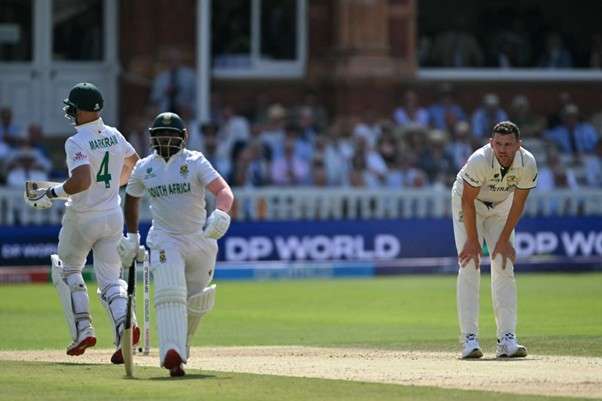
The World Test Championship (WTC) Final between Australia and South Africa was a thrilling encounter that showcased exceptional cricketing skills. However, Australia‘s bowling performance was inconsistent, ultimately costing them the title. We will explore the details of their blowing failures and how they impacted the outcome of the match.
The inability to contain South Africa’s batsmen
South Africa’s batsmen, particularly Aiden Markram and Temba Bavuma, played a crucial role in their team’s victory. Markam’s remarkable century (136 runs off 226 balls) and Bavuma’s gritty batting (66 runs in the second innings despite a hamstring injury) were instrumental in South Africa’s win. Australia’s bowling, including Mitchell Starc and Josh Hazlewood, struggled to make an impact despite taking crucial wickets.
The inability to contain South Africa’s starsmen was a significant factor in Australia’s loss. Aiden Markram and Temba Bavuma’s partnership was crucial in the South Africa chase, and Australia failed to break it. This allowed South Africa to build the momentum and ultimately win the match.
Static analysis of Australia’s bowling
A closer look at the bowling statistics of Australia’s key bowlers reveals some concerning trends.
- Pat Cummins: Cummins took 6/ 28 in his first innings but failed to repeat his performance in the second innings. His economy rate was concerning, allowing South African batsmen to score freely . Cummins’ inability to maintain consistency throughout the match was a significant factor in Australia blowing failures.
- Mitchell Starc : Starc took 2/ 34 in the first innings, but conceded runs at a steady rate. His inability to take crucial wickets at critical times hurt Australia’s chances. Starc’s lack of impact in the second innings was a major concern for Australia.
- Josh Hazlewood: Hazlewood took 1/27 in the first innings but was expensive in the second innings. His lack of control and inability to contain South Africa’s starsmen were significant factors in Australia’s bowling failure. Hazlewood’s inconsistency was a major concern for Australia’s bowling attack.
- Nathan Lyon: Lyon was given short spells, particularly in the final overs of the third day. When Markram and Temba Bavuma were batting cautiously. This limited his ability to make an impact and take crucial wickets. Lyon’s lack of opportunities to bowl long spells may have contributed to his inability to make a significant impact in the match.
The impact of Australia’s bowling failures
Australia’s inability to contain South Africa’s starsmen ultimately cost them the title. Despite having a 74-run lead after the first innings, they failed to bowl out South Africa in the second innings. South Africa’s followers, particularly Kagiso Rabada and Lungi Ngidi, played a crucial role in the team’s victory. Rabada took 9 wickets in the match while Lungi Ngidi took three crucial wickets in the second innings.
Australia’s bowling failures ultimately cost them the WTC final 2025 title, highlighting the need for improvement in the bowling department to succeed in future tournaments.