
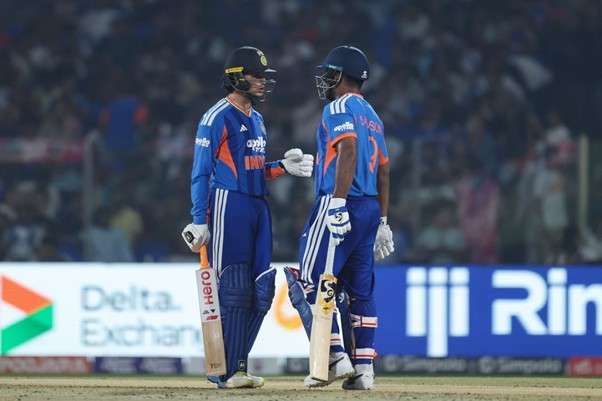
Afghanistan went down for the second consecutive time as the Men in Blue were too hot to handle in New Delhi. For the second consecutive time, Afghanistan had to bat first and could not post a big enough score, and India chased down the total with ease without breaking a sweat. Afghanistan are suffering in both departments, and that is not helping their cause at all. Some bizarre tactical calls have also left people scratching their heads. We will try to decipher why Afghanistan have not been able to challenge India in this second match as well.
Losing wickets in clusters in the middle phase dented Afghanistan
Afghanistan lost the toss and batted first, and for the second game running, lost Gurbaz for a duck. That is two ducks in a row for the keeper-batter. Thereafter, Ibrahim Zadran and Sediqullah Atal tried to steady things and did so by adding 51 runs for the second wicket. But because they lost Gurbaz early, the acceleration was not there as the Afghans managed 41/1 in the power play, which in New Delhi with wickets in hand is considered under-par.
But the problem happened in the middle phase. After putting 51 for the second wicket, Ibrahim, the skipper, was dismissed for 37. Atal too followed suit back to the hut after 8 more runs were scored. Wickets started to fall now as Gulbadin Naib went early at the score of 67. A brief partnership between Darwish Rasooli and Azmatullah Omarzai took the score to 96 before Omarzai fell, and 4 runs later Rasooli also went back to the hut. All of a sudden, Afghanistan were reduced to 100/6 in 14.1 overs.
Thereafter, there was a recovery thanks to Rashid Khan and Mohammad Nabi, which eventually allowed them to set India 160 runs. But that target was never going to threaten India in New Delhi and proved to be the case. The series is lost, but a lot to play for in the 3rd and final match in New Delhi. Afghanistan first has to hope they bat second, and hope their top order fires because that is what is plaguing them at this stage. Gurbaz really needs to fire, as his two failures have exposed where Afghanistan lacks.
Inability to contain Sanju Samson & Abhishek Sharma in the power play sealed the fate of the match
After posting a fighting 159 on the board, Afghanistan would have hoped for early wickets to challenge India. But for the second game in a row, India came out all guns blazing. After starting the chase in a normal fashion for the first three-four overs, the duo went berserk to end the power play on a high. Abhishek was the initial aggressor, which allowed the out-of-form Samson to get his eye in and settle on the wicket. But after 3-4 overs, Sanju took over and played some delectable shots.
The duo of Abhishek and Sanju complemented each other really well. They matched shot per shot and never allowed Afghanistan a foot in the door. The duo smashed 82 runs in the power play of 6 overs and 88 for the first wicket before being separated. Once India were 82/0 in 6 overs in a chase of 160, half the job was done with only 78 needed off 84 balls from there on. Thereafter, both Abhishek and Sanju fell after the power play, but they had done the job and allowed the rest to complete the formalities, which was done inside 15 overs.
Afghanistan struggled with the new ball in the power play and must find answers to getting wickets and stem the flow of runs in that phase, if they want to push India. So far, it’s been all India and one-way traffic. Maybe next game, Afghanistan might bat second, and that can flip the narrative a bit, but the gap between the two sides is massive at this stage across the formats. Rashid Khan bowled well, but the rest struggled with lines and lengths.
Bizarre captaincy by Ibrahim Zadran exposed Afghanistan
Another important thing that caught our attention was the usage of bowlers by captain Ibrahim Zadran. Ibrahim, who is captaining in his first series in the shortest format, looked clueless on the field and made errors. It’s one thing to make errors, but also blunders that need to be talked about and addressed by the team management. Fazalhaq Farooqi is a new-ball bowler and is supposed to be their spearhead. But the great Ibrahim did not start the bowling with him.
Instead, spinners Mujeeb and Nabi were given the ball initially. Understandably, one spinner starting the bowling from one end, but both spinners starting was a wrong call. We understand Farooqi went for runs in the previous game with the new ball, and that can happen to any bowler on a given day in this format. But not going to him at all irked one and all. Farooqi came to bowl for the first time in the 13th over. What’s the use of bringing him when the match was over?
This move defied logic, as the Afghans must have seen how Nitish Kumar Reddy, Arshdeep Singh, and Jasprit Bumrah were successful in the first innings. They could not learn from that and made mistakes, especially Ibrahim. Plus, the usage of other bowlers was also far from satisfactory. Rashid Khan’s last over happened when the game was over. So, a lot of leadership issues for Ibrahim. Yes, it is his first series, and he will learn from the experience. For Afghanistan to challenge India, Ibrahim has to upgrade his captaincy and lead in a proper way.
What Lies Ahead
So, India lead the series 2-0 and will want to clean sweep the series 3-0 when the two teams meet on 17th September, 2026, i.e. Thursday at New Delhi from 7:30 PM IST onwards. India will make changes to their XI as hinted by their captain Shreyas Iyer and may want to bat first as well to challenge themselves with the series won. Afghanistan would like to chase for sure, but must bowl well to keep India to a gettable score if they are chasing. Can they avoid a whitewash?
We shall find all the answers in the series finale on 17th September, 2026 in New Delhi.
Also Read: AFG vs IND: Sanju Samson’s Blazing Half-Century Flattens Afghanistan