
Rudi van Vuuren believes the future of Associate cricket lies in T20Is despite growing criticism over the revamped 2027 ODI World Cup format. ICC decision to revamp the 2027 ODI World Cup format has sparked widespread debate among Associate nations, with many questioning whether the changes undermine cricket’s promise of global expansion.
However, Namibia Cricket chair and newly appointed ICC board member Rudi van Vuuren has urged teams to look beyond the immediate disappointment and focus on what he believes is a much bigger opportunity for Associate cricket.
Speaking during the launch of the 2027 ODI World Cup in Johannesburg, van Vuuren acknowledged the frustration surrounding the revised tournament structure but insisted that the game’s future, particularly for Associate nations, could lie in the T20 format.
Why the New ODI World Cup Format Has Drawn Criticism
The controversy stems from the introduction of a Super Series in the 2027 ODI World Cup. Under the revised structure, two teams will be eliminated after playing just two matches, significantly reducing opportunities for lower-ranked nations to compete against the world’s best.
For Associate teams that have spent years battling through the ICC Cricket World Cup League 2 and Cricket World Cup Challenge League pathways since 2024, the late change has come as a major setback. Namibia (28 points in 32 matches & are at 5th position) hasn’t got automatic qualification despite being co-hosts who would have to play ODI WC 2027 Qualifiers if they make it there, as not all teams are yet finalized. The top 4 teams of ICC ODI Super League 2 will play ODI WC Qualifiers, as Namibia will have to pull up their socks.
Namibia captain Gerhard Erasmus expressed disappointment, saying qualification should offer teams “a real opportunity to compete on the biggest stage rather than simply earning a place in the tournament”
Similar concerns were echoed across the Associate cricket community. Former Netherlands captain Scott Edwards questioned the ICC’s commitment to growing the game globally, arguing that decisions like these reduce opportunities for emerging nations. Scotland skipper Richie Berrington also called for greater consultation with Associate members before major structural changes are introduced.
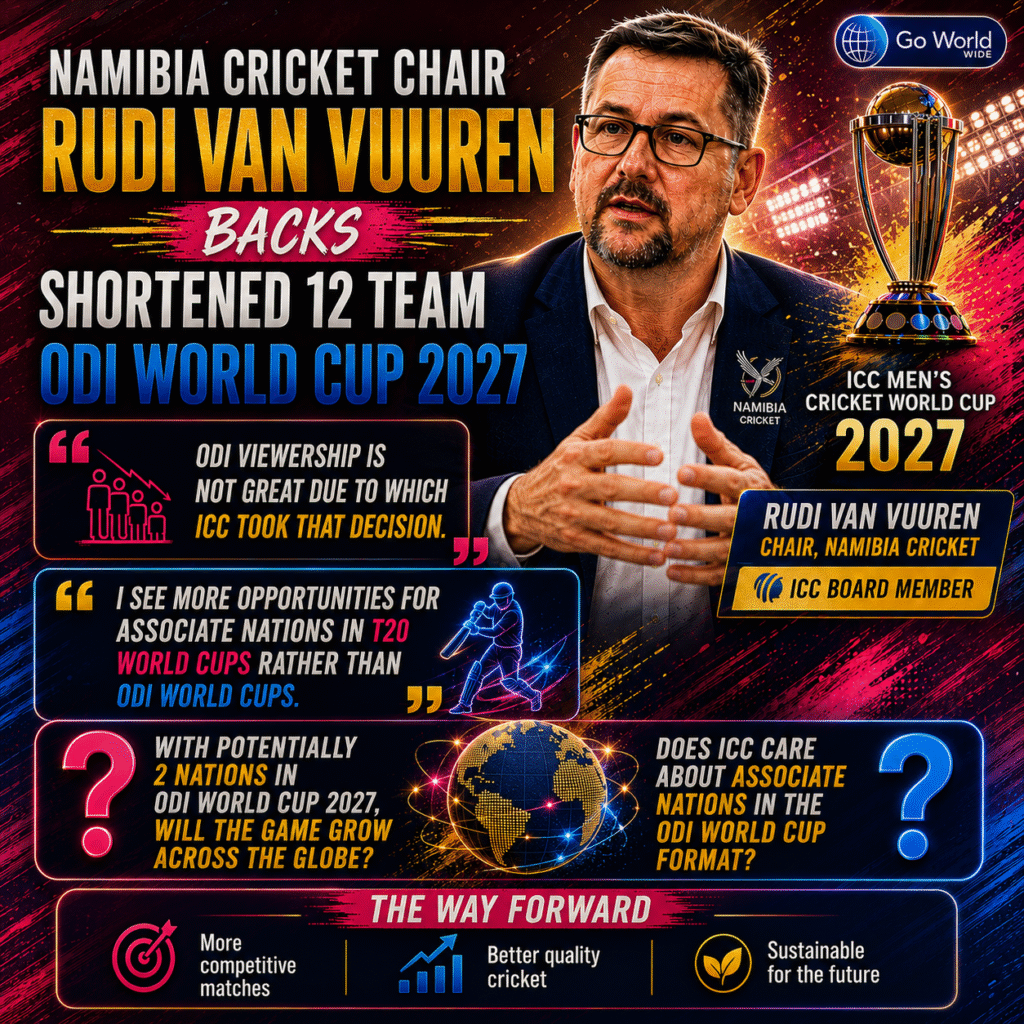
Rudi Van Vuuren: ‘Look at the Bigger Picture’
While accepting the concerns raised by players and administrators, van Vuuren believes the decision makes more sense when viewed in the context of cricket’s changing landscape.
“If you understand the bigger picture, it makes sense,” he said.
He pointed to the uncertain future of 50-over cricket, highlighting declining viewership and changing audience preferences.
“If you look at viewership numbers or if you look at popularity for ODI cricket, we don’t really know where it is going. I do see more opportunities for Associates in the T20 world,” van Vuuren said.
According to him, the ICC’s long-term strategy is likely to shift investment towards the shortest format, where Associate nations have a greater chance of competing regularly at the highest level.
T20 Cricket Could Become the New Growth Engine
Van Vuuren believes future ICC funding models will increasingly prioritise T20 World Cups, creating more opportunities for Associate nations to receive financial support and participate in elite competitions.
Although the ICC is yet to finalise its post-2027 financial model, discussions are expected once a new global media rights agreement is negotiated. Van Vuuren suggested that future investments will be directed towards expanding cricket through the T20 format rather than traditional 50-over cricket.
The T20 pathway itself is also evolving. Beginning with the 2028 T20 World Cup, regional qualification tournaments will be replaced by a global qualifier, allowing the highest-performing Associate nations to compete directly for World Cup spots regardless of their continent.
ICC ODI Super League 2 points table
| Rank | Team | M | W | L | T | N/R | PTS | NRR |
|---|---|---|---|---|---|---|---|---|
| 1 | United States of America | 32 | 21 | 10 | 0 | 1 | 43 | +0.693 |
| 2 | Scotland | 33 | 16 | 10 | 0 | 7 | 39 | +0.631 |
| 3 | Netherlands | 32 | 17 | 11 | 0 | 4 | 38 | +0.215 |
| 4 | Oman | 28 | 14 | 11 | 0 | 3 | 31 | +0.018 |
| 5 | Namibia | 32 | 13 | 17 | 0 | 2 | 28 | -0.387 |
| 6 | Canada | 29 | 10 | 14 | 0 | 5 | 25 | -0.203 |
| 7 | Nepal | 32 | 11 | 19 | 0 | 2 | 24 | -0.089 |
| 8 | United Arab Emirates | 26 | 7 | 17 | 0 | 2 | 16 | -1.016 |
ICC’s Long-Term Vision
The ICC continues to evaluate the future of international cricket, with consultancy firm McKinsey & Company expected to present a strategic report during the board’s November meetings. Discussions around the Future Tours Programme (FTP) for 2027–31, funding structures, and the possible expansion of the World Test Championship are also expected to shape the game’s future.
“The chairman, Jay Shah, has a big vision to grow cricket into the biggest sport in the world,” he said. “If you want to do that, you have to grow the Associate teams. And to do that, you have to create more opportunities for Associates.”
For many Associate nations, the debate over the 2027 ODI World Cup is far from over. But as cricket continues to evolve, the focus may increasingly shift from preserving tradition to creating sustainable opportunities in formats that promise wider global growth. It would soundvery harsh but it seems that ICC has made it clear focus on T20 WCs rather than traditional format to associate nations.
Also Read: ICC ODI WC 2027: Bhuvneshwar Kumar Breaks Silence Of ODI Comeback