
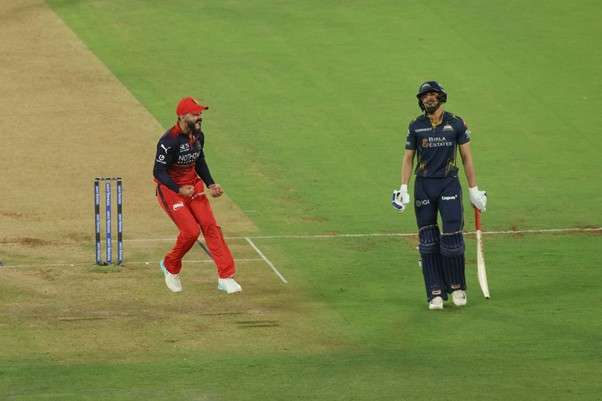
Big finals often demand strong starts from top-order batters, but Gujarat Titans(GT) experienced the exact opposite in the IPL 2026 final against Royal Challengers Bengaluru. Chasing a second consecutive title, RCB’s bowling attack dismantled GT‘s top order inside the powerplay, leaving the batting unit under immense pressure and ultimately restricting them to just 155/8 in 20 overs.
The Titans entered the final with one of the most reliable top orders of the season, featuring captain Shubman Gill, Sai Sudharsan, and N. Sindhu. However, on the biggest night of the tournament, none of them managed to play the defining innings GT desperately needed.
Shubman Gill’s Early Exit Sets the Tone
Much of Gujarat’s batting success throughout the season revolved around Shubman Gill providing solid starts at the top. The captain looked positive early, striking 10 runs off just 8 balls with two boundaries.
However, his stay was cut short in the third over when Josh Hazlewood forced an error that resulted in a catch by Rajat Patidar. Gill’s dismissal at 22/1 in 2.2 overs immediately shifted momentum towards RCB.
The wicket was significant not only because it removed Gujarat’s captain but also because it exposed the middle order much earlier than expected. Finals are often about absorbing pressure during the initial overs, and Gill’s departure denied GT that stability.
Sai Sudharsan Fails to Make an Impact
If Gill’s dismissal was a setback, Sai Sudharsan’s wicket made the situation even worse. Sudharsan, who had been among Gujarat’s most dependable performers during the campaign, struggled to find fluency against RCB’s disciplined pace attack.
The left-hander scored only 12 runs from 12 deliveries before edging Bhuvneshwar Kumar behind to wicketkeeper Jitesh Sharma. When Sudharsan departed at 26/2 in 3.4 overs, Gujarat had already lost both openers inside the powerplay.
The early wicket ensured that GT could not capitalize on fielding restrictions. Instead of building a platform for a score above 180, they were forced into recovery mode almost immediately.
Powerplay Pressure Changes the Entire Innings
At 26/2, Gujarat’s plans had already been disrupted. The responsibility shifted to N. Sindhu and Jos Buttler, who attempted to rebuild the innings cautiously.
While the pair added valuable runs, the pressure created by the early wickets never truly disappeared. Both batters were forced to spend time settling in rather than attacking from the outset. As a result, Gujarat’s run rate remained under control throughout the middle overs.
The contrast between the two teams’ starts was striking. While GT lost both openers cheaply, RCB later raced to 62 runs inside 4.3 overs during the chase, highlighting how damaging Gujarat’s top-order collapse had been.
Nishant Sindhu & Jos Buttler Unable to Convert the Start
Among the top three, N. Sindhu stayed the longest but could only manage 20 runs off 18 balls. He struck three boundaries and briefly looked capable of anchoring the innings.
However, just as he seemed ready to accelerate, Rasikh Salam removed him at 55/3 in 7.6 overs. The dismissal further exposed Gujarat’s middle order and prevented the formation of a substantial partnership.
With all three top-order batters dismissed for a combined 42 runs from 38 balls, Gujarat never recovered fully from the early damage. Jos Buttler (19 in 23) was seen struggling as he was foxed by Krunal Pandya in 13th over by bowling a slider and he was stumped when GT’s score was 73-4 in 12.1 overs.
A Collapse That Defined the Final
Washington Sundar’s unbeaten fifty later helped Gujarat cross the 150-run mark, but the innings always felt below par considering the batting talent available. The foundation of a strong total is usually laid by the top order, and GT’s top three failed to provide that platform.
Gill’s aggressive start ended too soon, Sudharsan couldn’t settle, and Sindhu failed to convert his promising knock into a match-defining innings. Together, their dismissals handed control to RCB’s bowlers and forced Gujarat onto the defensive for most of the contest.
In the end, RCB chased down the target with 12 balls to spare, securing a five-wicket victory and another IPL trophy. While several moments influenced the result, the Gujarat Titans’ top-order collapse remains the biggest reason their batting innings never truly took off. On a night when their biggest stars were expected to lead from the front, the early setbacks proved impossible to overcome.
Also Read: RCB vs GT: King Virat Kohli Seals Back-To-Back Titles For RCB