
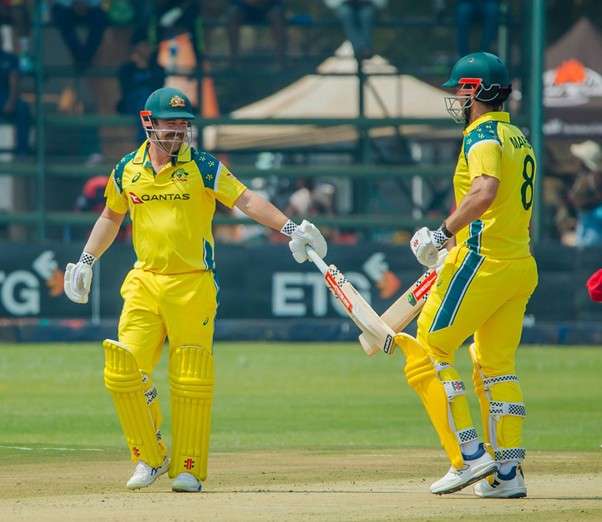
Hosts Zimbabwe had their moments and fought hard. But that was not good enough as they went down to the mighty Australia by 84 runs as the reigning world champions clinched the series 2-0 with a game to spare. Zimbabwe tried hard, but Australia were too hot to handle and registered a good win in the end. The Chevrons had their moments, but lacked a little bit in crunch situations. We will try to analyse the reasons for their loss to Australia in the 2nd ODI in Harare.
Inability to dismiss the opening pair of Travis Head & Mitchell Marsh for close to 19 overs costs Zimbabwe
It was Zimbabwe who won the toss and put Australia into batting first, which the Aussies didn’t mind as they wanted to bat first anyway. From thereon, it was the Travis Head show as he mesmerised one and all in Harare with his dominant display. His captain Marsh supported him well and played second fiddle throughout, but Head was unstoppable. The duo managed to amass 78 runs in the first 10 overs to lay the platform.
That was not all. They carried on batting beyond the powerplay and showed their class. Both completed their fifties in contrasting fashion in terms of balls taken. Head was the aggressor of the two. The Chevrons were deemed ineffective as they failed to get a wicket with the new ball and leaked runs. Yes, there is no Richard Ngarava, but Blessing Muzarabani has been disappointing, to say the least, going wicketless in the first two games. The others that have taken wickets have leaked runs.
Zimbabwe have looked ineffective to say the least, with the ball. They started well in the first ODI before losing the plot and here also, they were searching for answers. They were waiting for things to happen rather than make things happen. They were taken for runs totally. In the final ODI, the Chevrons will hope for early wickets as the Aussies can be put under some pressure with early wickets lost. But yesterday, after a partnership of 130 in 19 overs, the platform was laid for a big total, and that is exactly how it played out in Harare.
Conceding 101 runs in the last 10 overs sealed the fate of the match
Australia were always maintaining a fair clip in their innings. They reached 200 in 30 overs but one felt Zimbabwe pulled it back a bit, keeping Australia to 255/3 in 40 overs. They bowled a tad better in that phase, but the Aussies had wickets in hand. In the back ten overs, you are bound to go for runs as a fielding side, but some sort of control was needed to stem the flow of runs. Conceding 70-80 would have been considered decent considering 7 wickets in hand for Australia.
But Zimbabwe conceded 101 runs in the back 10 overs. Yes, they picked up 3 wickets, but that becomes immaterial with the batting side having wickets in hand. The death bowling left a lot to be desired as they bowled slot and length balls and were taken to the cleaners. Cooper Connolly did it, and so did Matt Renshaw, before the finishing kick was provided by Oliver Peake. Peake scored 41* off 18 balls, which included 24 runs off the final over bowled by Brad Evans.
Evans may have picked up 3 wickets in total, but went for plenty, and the figures got spoilt in the end. Blessing was wicketless and went for runs. The others also were not that impressive. Death bowling woes were brought to the fore. The Chevrons were ineffective with the ball in the death overs, and they need to sort that out soon. They conceded a lot in the first game and got exposed today as well. So, ahead of the final ODI, the aim will be to tighten up this area and not give easy runs to Australia.
Batters unable to convert starts into big scores underlines Zimbabwe’s problems
There was another interesting aspect we noticed in this game when the Chevrons came to chase 357. It was the frequent or starts that the batters got, but no one converted that into a big score. That was the difference between the two teams, one felt. Most Zimbabwe players got starts but never carried onto score something significant. Lots of 20s and 30s and 40s, but no one got above 45. That was the main difference.
Pretty 20s and 30s are good for T20Is, but they are never enough in 50-over cricket, and that is a given fact. To put things into perspective, Travis Head got a hundred, Mitchell Marsh and Cooper Connolly got fifty-plus scores, so the top 3 scored beyond 50. While there were 20s and 30s down the order, Oliver Peake’s 41* off 18 balls proved the icing on the cake. Compare that to Zimbabwe, and the scores were all 20s and 30s, with Raza getting 45. But no 50+ score is what made the difference in the end.
Looking ahead to the 3rd ODI, Zimbabwe batters will want to convert those starts into big scores in order to put some pressure on Australia. In 50-over cricket, big scores are the need of the hour, and Zimbabwe needs to adhere to this philosophy if they want to achieve something in this series. Scoring 272 against a quality attack is credible, but the Chevrons will look to improve and get better at it as we go along the series. The hosts tried their hearts out but needs to work on a few areas to get better at things.
What Lies Ahead
So, Australia have sealed the series 2-0. They would like to sweep it in the 3rd and final ODI on Sunday, September 20th at 1 PM IST. Zimbabwe would try hard to pull one back and play for pride to end the season on a high. Expect a few changes and experiments perhaps in both sides. Let’s see how the final ODI plays out in Harare on Super Sunday.
Also Read:Â ZIM vs AUS: Travis Head & Co Hammer Zimbabwe