
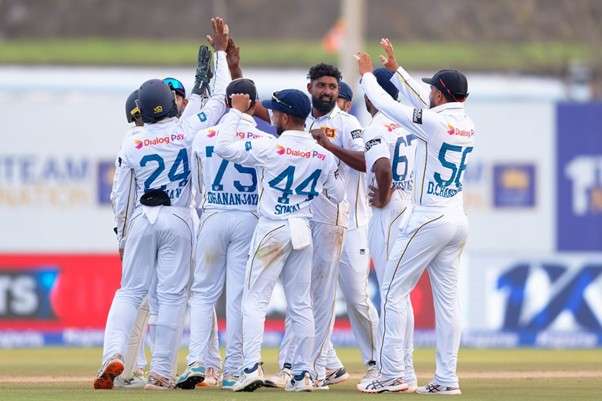
Sri Lanka’s fragile batting line-up was thoroughly exposed as India secured a commanding 165-run victory. Sri Lanka struggled to cope with India’s disciplined bowling attack across both innings, with repeated collapses putting the team under pressure.
Although Sri Lanka had individual performances from Sonal Dinusha, Niroshan Dickwella and Dhananjaya de Silva, the lack of consistency from the rest of the batting order proved costly. India’s ability to take wickets at crucial moments ensured that Sri Lanka never looked capable of seriously challenging the target.
A Promising Start That Quickly Turned Into a Collapse
Sri Lanka’s first innings provided an early indication of their batting problems. After India posted a massive 462, Sri Lanka needed a strong response, but Niroshan Madushka was dismissed for just 0 from two balls, putting immediate pressure on the top order. Lahiru Udara offered some resistance with 27 off 44 balls, but Dinesh Chandimal could manage only 4 from 16 deliveries, while Kusal Mendis was dismissed for 14 from 25 balls.
Dhananjaya de Silva then contributed 21 from 41 balls, but Sri Lanka were already five wickets down for only 90 runs. That collapse placed the responsibility on the middle and lower order to rescue the innings. Sonal Dinusha eventually produced the standout performance, scoring a magnificent 100 off 168 balls with four fours and two sixes.
Dickwella also played an important knock of 80 from 115 deliveries, but their efforts were not enough to prevent Sri Lanka from being bowled out for 284. The biggest concern was the lack of meaningful contributions around the two main batters. Once their resistance ended, Sri Lanka’s lower order failed to add the runs required to reduce India’s advantage.
Sonal Dinusha & Niroshan Dickwella could not repair the Damage
The partnership between Sonal Dinusha and Niroshan Dickwella gave Sri Lanka their best chance of recovering in the first innings. Dickwella’s 80 and Dinusha’s century helped Sri Lanka move beyond 200, but the team had already surrendered too much ground. Sri Lanka reached 236/6 when Dickwella was dismissed, and the remaining batters could add only 48 more runs before the innings ended at 284.
India’s bowling attack maintained pressure throughout, with Ravindra Jadeja taking 3/57 and Manav Suthar claiming 4/76. The spinners repeatedly forced Sri Lankan batters into difficult situations, while Mohammed Siraj and Prasidh Krishna provided support with the new ball and later spells.
The problem for Sri Lanka was not simply the failure of one or two batters. Their batting structure lacked enough reliable players capable of staying at the crease for long periods. Whenever India removed a set batter, another collapse followed soon after.
Second Innings Exposes the Same Weakness
The second innings made Sri Lanka’s batting concerns even more obvious. Chasing 372, Sri Lanka needed a strong opening partnership, but Nilshan Madushka was dismissed for 6 from 27 balls. Pathum Sooriyabandara then fell for a duck, while Kusal Mendis managed only 2 from 12 balls. With Sri Lanka reduced to 47/4 after Lahiru Udara’s dismissal for 16, the pressure was once again on the middle order.
Dhananjaya de Silva and Sonal Dinusha attempted to rebuild the innings. De Silva scored 59 from 151 balls, showing considerable patience, while Dinusha followed his first-innings century with another valuable contribution of 84 from 128 balls. Their partnership briefly gave Sri Lanka hope of extending the contest.
However, once de Silva was dismissed at 142/5, Sri Lanka’s resistance weakened rapidly. Dickwella contributed only 10, while Kusal Nuwanthwa made 20 before falling to Suthar. Prabath Jayasuriya and Lahiru Kumara were both dismissed without scoring, leaving Sri Lanka all out for 206.
Manav Suthar Punishes Sri Lanka’s Batting Fragility
Manav Suthar was central to India’s dominance in the second innings. The left-arm spinner delivered an outstanding spell of 6/55 in 23.4 overs, constantly putting Sri Lanka’s batters under pressure. His wickets included important dismissals of Sooriyabandara, de Silva, Dinusha, Nuwanthwa and Jayasuriya, making him the biggest reason Sri Lanka failed to build a sustained chase.
Prasidh Krishna also impressed with 2/16 from 10 overs, while Mohammed Siraj took 1/15 from nine overs. Ravindra Jadeja added another wicket after already taking three in the first innings. India’s bowlers did not allow Sri Lanka’s batters to settle, and the pressure eventually produced another collapse.
Sri Lanka’s Over-Reliance on a Few Batters
The clearest takeaway from the match is Sri Lanka’s heavy dependence on a small group of players. Sonal Dinusha was the only batter to score a century in the first innings and followed it with 84 in the second, while de Silva and Dickwella also made useful contributions. However, the top order repeatedly failed to provide a solid platform.
Sri Lanka’s first innings saw them lose five wickets for 90 runs before Dinusha and Dickwella attempted to rebuild. In the second innings, they were again struggling at 47/4 before de Silva and Dinusha provided resistance. Such repeated early collapses make it extremely difficult for a team to compete against an attack as disciplined as India’s.
India’s Bowling Exposes a Serious Batting Concern
India’s 165-run victory was not just a result of their strong batting performance; it also highlighted a major weakness in Sri Lanka’s batting line-up. India scored 462 in the first innings and added 193 in the second, giving their bowlers enough runs to attack without pressure. Sri Lanka, meanwhile, were dismissed for 284 and 206.
The scorecard tells a clear story. Sri Lanka had players capable of producing big individual performances, but they lacked consistency throughout the order. Dinusha’s 184 runs across the two innings and de Silva’s 80 runs in total were overshadowed by repeated failures around them.
For Sri Lanka, the defeat should be viewed as a warning rather than simply another loss. Their fragile batting line-up needs greater stability at the top and stronger support for their middle-order players. Until more batters consistently contribute, strong bowling attacks like India’s will continue to expose the same weakness.
Also Read: SL vs IND: Sonal Dinusha’s Spirited Knocks In Vain